On the run (4): According to Oussama Diab, war destroys not only houses, but also the souls of people.
-
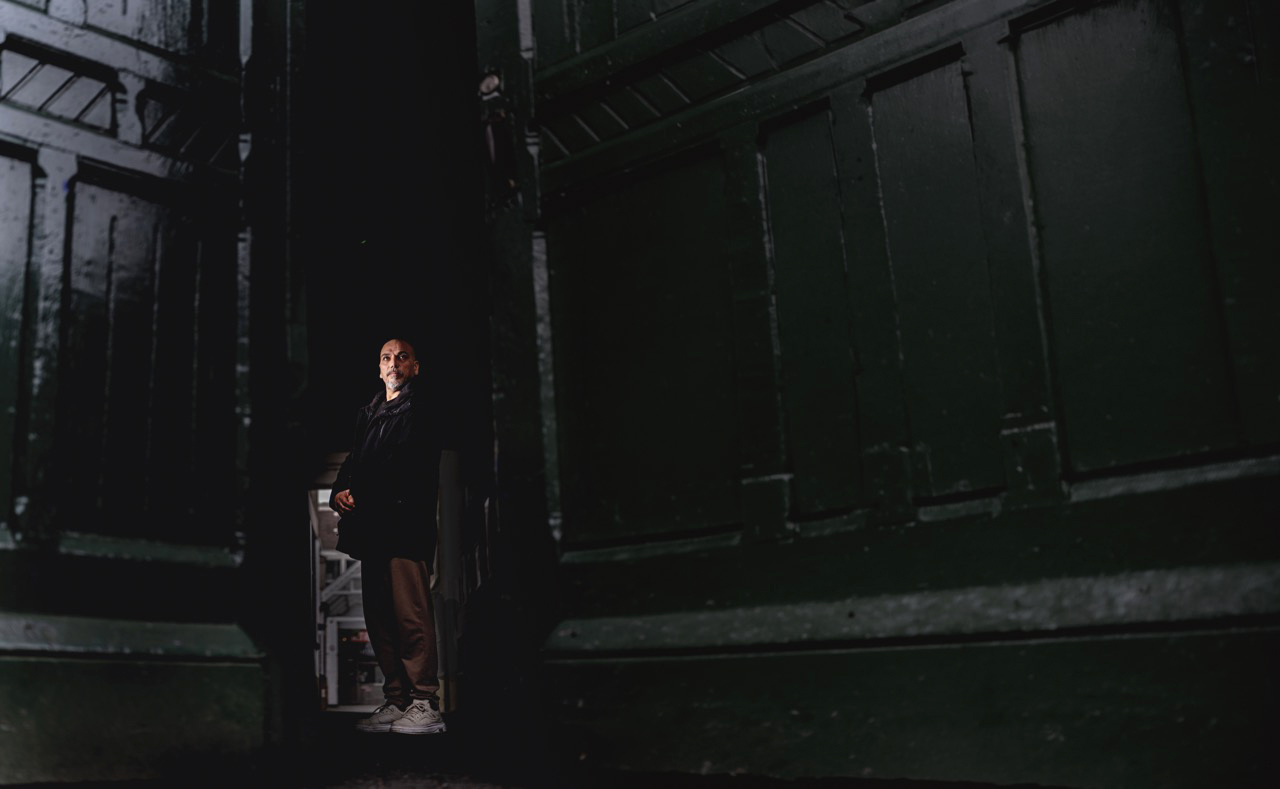 Oussama Diab. Foto: Duncan de Fey
For many people in Nijmegen, war feels like something distant and abstract. But not for artist Oussama Diab (47). In 2015, he arrived from Syria in Heumensoord, the large refugee camp behind Radboud University. Now he paints in a studio in the Paraplufabriek.
‘Two months ago, I was in Syria. My brother was with me and asked, ‘Do you want to see the place where your house used to stand?’ ‘I’d rather keep my distance’, I said. I found it too painful. Nothing at all remains of the neighborhood where I lived in Damascus. Absolutely everything has been wiped away. It will take years and years before anything is rebuilt there and people can return.
New magazine
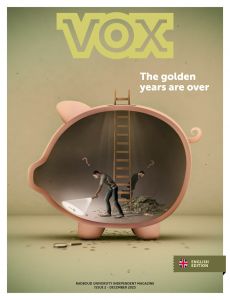
This article is from the new Vox magazine, a special issue on the Military. How should Radboud University deal with the Military? What collaborations exist – and how ethical is it to have ties with the Military in times of war? You can also read the new magazine (in Dutch) via this link.
My wife and I had a very beautiful house. It was only a year old when we left it behind. The unrest in my country began with peaceful protests against the Assad regime. Just like earlier in Tunisia and Egypt, the Arab Spring reached Syria. At first there were only weekly demonstrations on Fridays, but over time there were protests every day, and the response became increasingly violent. Bombs fell on my neighborhood; people died every day.
I worked as an artist and created New Guernica as a veiled commentary on the war in Syria. It was based on Picasso’s famous work. CNN interviewed me about that painting. The article went further than what I had said. If the regime found out, I would be in danger. That’s when I knew I had to flee.’
Many friends
‘After staying in Lebanon for a while, I arrived in Heumensoord in 2015, the large refugee camp behind Radboud University. I didn’t know anyone here, but in the six months I stayed in Heumensoord I made many friends. There were various connections with the university. Some of my work is now displayed in the Grotius Building, and last summer I created a mural in the city center as part of the Waalpaintings series, a collaboration between the municipality and the university. I have a studio in the Paraplufabriek, where I am almost every day.
My parents are from Palestine. When they had to flee their land during the founding of the state of Israel in 1948, they ended up in Syria. I was born in Damascus. History is repeating itself, because I too have had to leave my country. This all comes back in my work—sometimes very explicitly, sometimes less so. But history naturally continues to shape my identity.
Two months ago, I was in Syria because I wanted to see my father. He is old and ill. For the first time, my brother and I also visited my mother’s grave. She passed away while I was in the Netherlands. At the cemetery, I spoke to her. She was a wonderful mother. It saddens me that she often used to ask when I would have children. By the time I did, I was far away from her. She only saw my daughter once in real life, when she was a baby.
War doesn’t only destroy houses, buildings, and trees—it destroys people’s souls. Something in us has been broken forever.’