Navigation lessons from birds
-
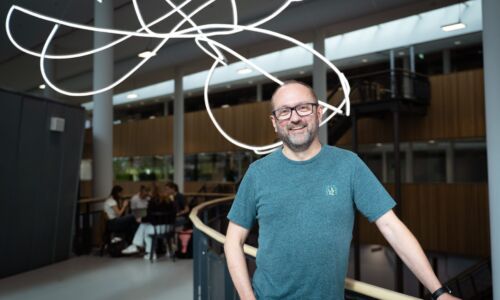
 Sara Matiş. Photo: Dick van Aalst.
Columnist and neurobiology student Sara Matiş finds comfort in the animal world. This time: on migratory birds.
There is something so special about birds flying in a ‘v’ formation. They do this because the flapping of their wings gives an uplift to the bird behind, which helps conserving energy during migrations. It’s similar to how cyclists draft behind one another to reduce drag. It’s a marvellous example of natural engineering, if you ask me.
When I’m feeling down, I look at birds a lot. And lately, I’ve been feeling lost, to say the least. And homesick. I’ve been missing home, or more like feeling at home. In my body, in my life.
After you strip the achievements, roles and titles you identify with, what or who remains underneath all of that? What is there to say after all distractions are turned off and it gets quiet? What do you do when you measure your worth in the things you do, but you’re suddenly too tired to get started?
Honestly, I’m still navigating that – but I found some comfort in watching the birds migrate. You don’t always need to ‘travel solo’; you can let yourself be uplifted by the people next to you, much like birds do in a more literal sense. And there is no shame in feeling lost. It’s your body checking in on you. The system asks for a route recalibration – and that can be a very good thing. Not adjusting even a one-degree deviation in the beginning of a flight can make you land on a different continent.
This is another thing I find fascinating about migrating birds – their sense of direction. Some fly tens of thousands of kilometers and arrive every year at the right destination. They navigate using cues such as the sun and the stars and by sensing the Earth’s magnetic field. However, we’re not entirely sure how this built-in compass really works.
Sometimes, I feel like there is an endless journey ahead to find myself again. But when I strip down all the labels and have the courage to face the quietness, even if I don’t fully understand how it works, my internal compass somehow knows the route which takes me ‘home’. And that’s a marvellous example of natural engineering, if you ask me.
Sara Matiş studies neurobiology at Radboud University and is a columnist for Vox. She lives in Nijmegen and is originally from Timişoara, Romania.
Lees alle columns van Sara Matiş