How a Nijmegen–New York partnership is producing big discoveries at nano-temperatures
-
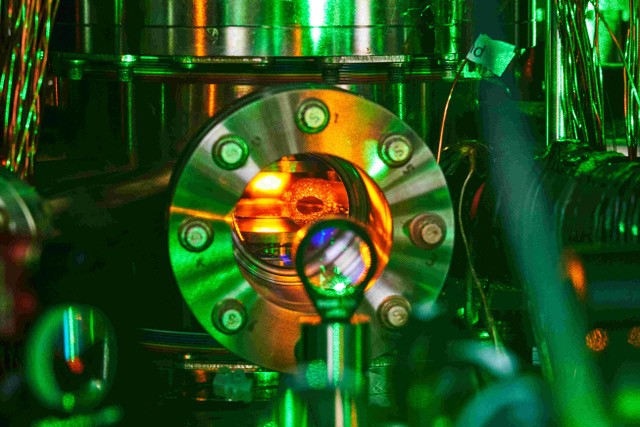 Beeld uit het lab. Foto: Columbia University
New quantum computers, or materials that conduct electricity without losing any energy: thanks to a collaboration between researchers in Nijmegen and New York, a host of revolutionary developments may lie ahead. The key: cooling molecules further than anyone has ever done before. 'This is still completely uncharted territory.'
What may well be the coldest place on the entire planet lies behind a sliding door on the ninth floor of the physics building at Columbia University. It is a shiny metal football. Cylinders protrude from six sides; some contain thin cables, others are thick tubes between half a metre and a metre long.
To be precise: inside, it is just one billionth of a degree above absolute zero, which is minus 273.15 degrees Celsius. That is almost 300 degrees colder than the rest of this physics lab and the New York campus outside, where an Indian summer is making this October morning pleasantly warm.
‘According to my astronomy colleagues, even the space between galaxies is warmer’
The sphere is so cold inside because it is almost a perfect vacuum, and the few thousand molecules still inside it are virtually standing still, explains research leader Sebastian Will. The physicist points to the metre-long tube that sticks into the sphere. ‘In there, sodium atoms are slowed down from 1,000 kilometres per hour to a standstill.’ That makes them ice-cold. ‘According to my astronomy colleagues, even the space between galaxies is warmer.’
And that is exactly the point. Will studies the properties of molecules at these extremely low temperatures. Scientifically, that is hugely interesting, because under such extreme conditions it is quantum mechanics that governs how particles behave – more on that in a moment.
Nobel laureates
Columbia University is the place for this kind of research. Walk into the hall of the physics building and you are stared down, intimidatingly, by portraits of more than ten Nobel laureates the institute has produced – from Enrico Fermi in 1938 to John Clauser in 2022. A hall of fame in the most literal sense.
To build ’the coldest molecule freezer on Earth’, Will works closely with Radboud researcher Tijs Karman, assistant professor at the Institute for Molecules and Materials. Karman devises new theoretical ways to cool molecules to extreme temperatures; Will turns those ideas into unique equipment for his experiments, together with a team of postdocs and master’s students.
Karman got to know Will as a postdoc at Harvard, he says a few days later in his office in Nijmegen, and became fascinated by cold molecules. ‘What happens at the quantum level is still largely unknown, but at the same time very promising.’
What kind of promising applications should we be thinking of? A new type of quantum computer, for instance, in which you can tune the quantum properties of molecules so that they act as the ones and zeros in lightning-fast calculations. Or a new way of simulating how electrons behave in certain materials. Karman: ‘That might help us better understand how superconductivity works at higher temperatures.’
The key to all this is creating a so-called Bose-Einstein condensate of molecules, a special state of matter predicted by quantum mechanics (see box). Will and Karman were the first in the world to achieve this with a sodium-caesium molecule, three years ago now. They managed it thanks to the extremely low temperatures in the high-tech set-up here in the New York lab.
A tour de force
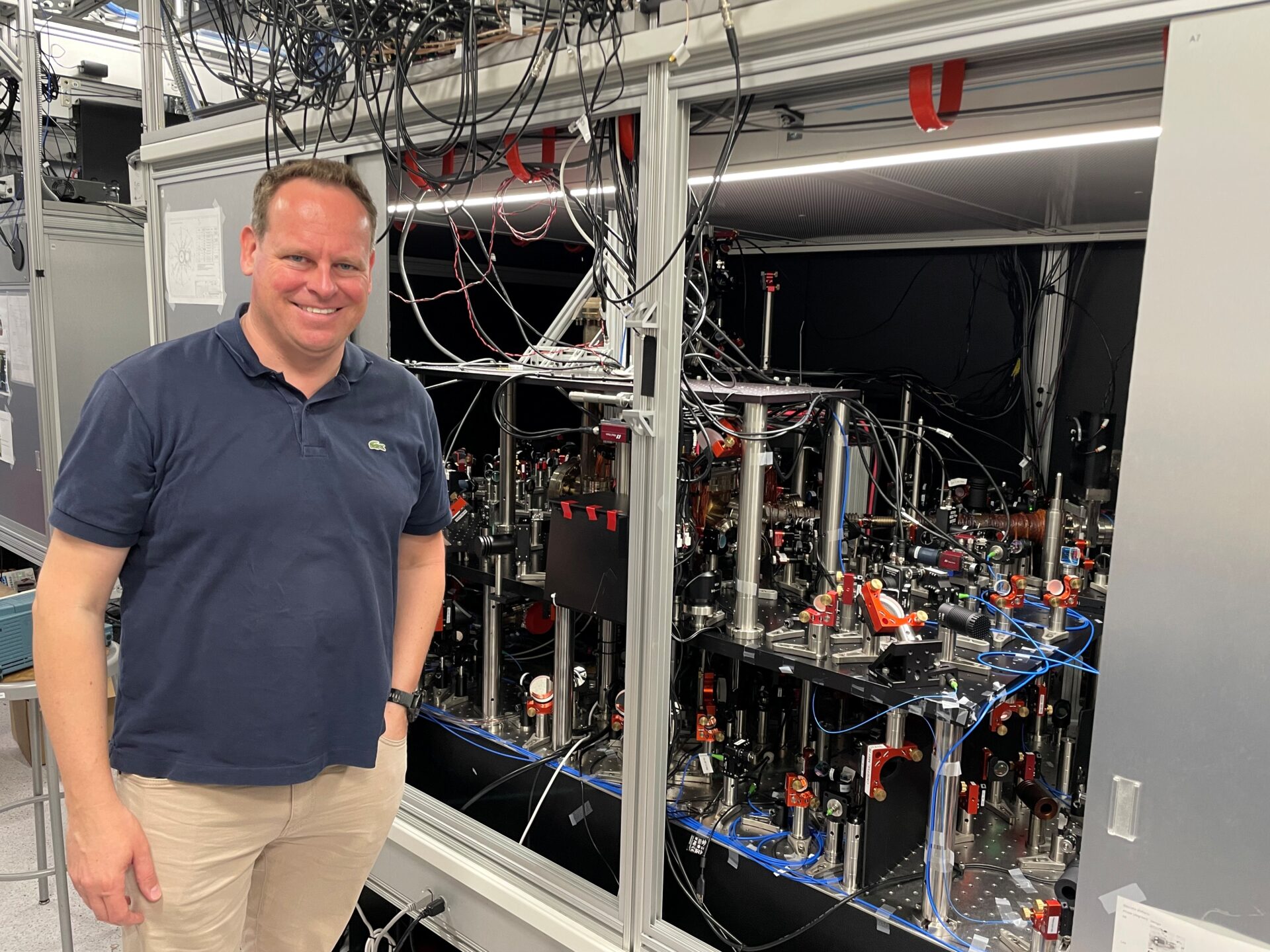
‘Of course I remember exactly when that was!’ says Will when asked, and starts scrolling through the photo library on his iPhone. Excitedly: ‘Look, here – it was 2 October 2023, at half past eight in the evening.’ He shows a photo of himself and fellow researchers, beaming as they look at a graph on a lab computer.
The achievement was nothing short of a tour de force. Such a condensate had already been created in the 1990s, but with atoms (which earned the researchers involved a Nobel Prize). ‘Atoms are relatively simple, though,’ says Will. ‘Molecules have far more interesting properties, partly because they can influence each other over much greater distances, through electrical forces – a bit like magnets. How does that play out under quantum conditions?’
Bringing molecules to a standstill, however, is another matter entirely. Unlike atoms, molecules tend to stick together. Will: ‘But when they collide, you lose them.’ The solution came from Nijmegen. Karman came up with a way of using microwaves (familiar from the kitchen microwave oven) to rotate the molecules so that they repel each other, which means fewer collisions.
One slightly twisted lens
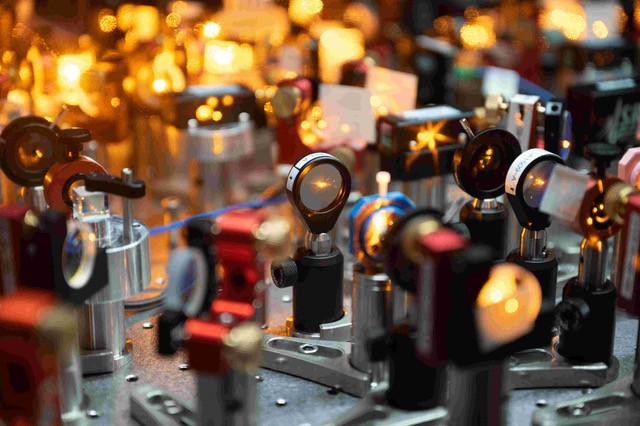
That sounds simpler than it is. In the Columbia lab, the metal vacuum sphere is surrounded by hundreds of small mirrors and lenses. They are needed because a laser first has to slow down the sodium and caesium atoms in exactly the right way, after which they fuse into molecules. Karman’s ‘microwave-oven waves’ then keep the molecules from colliding.
The equipment, precisely aligned, is bolted onto several platforms above and below the sphere. It looks a bit like peering under the bonnet of a Formula 1 car. Can the researchers themselves still make sense of the tangle of wires, tubes and lenses? Will laughs. ‘Everything does have to be extremely precise. If the experiment doesn’t work, it could be down to a million things, so to speak. A lens that turns out to be slightly twisted, for example, because the screw holding it in place has expanded due to a slightly higher temperature.’ That is precisely why there is sensitive climate and temperature monitoring in the lab and behind the sliding doors that house the equipment.
The intensive collaboration with theorist Karman – they confer every week – also produces quick, practical solutions, both say. Karman: ‘I had initially proposed a static electric field, for example, but then Sebastian asked: could it be oscillating waves instead, because that’s much easier for us to do technically? So you go back to your calculations, and it turned out that could work too.’
All that high-tech is paying off handsomely. Since the eureka moment on 2 October 2023, one groundbreaking discovery has followed another, along with top publications in journals such as Nature, Science and Physical Review Letters. These describe, among other things, how Will and Karman created quantum liquids from the ultracold molecules – and how they can pick up individual molecules and move them around in a grid, like eggs in an egg box.
Quantum computer
Why devote your career to such a complex and somewhat obscure branch of physics? Karman: ‘For me, on the one hand there’s the fundamental side of our project: how can we precisely control the interactions between molecules? And on the other hand, the potential applications for quantum technology are really exciting.’
‘What I find inspiring is that we’re in a similar position to the Dutch Nobel laureate Kamerlingh Onnes at the beginning of the twentieth century’
Will adds: ‘What I find inspiring is that we’re in a similar position to the Dutch Nobel laureate Kamerlingh Onnes at the beginning of the twentieth century, when he cooled helium to one and a half degrees above absolute zero.’ Metals that he then cooled with this liquid helium suddenly started behaving very differently. ‘They lost their electrical resistance and became superconducting.’ That in turn laid the foundation for new devices such as MRI scanners.
You never know what revolutionary applications fundamental research will eventually lead to, is the physicist’s point. Karman: ‘This is still completely uncharted territory.’
Bose-Einstein condensates
What exactly are Bose-Einstein condensates? To answer that, we need to dive a little deeper into physics. School textbooks often describe atoms and other particles as a kind of billiard ball. Using Newton’s laws, you can then calculate exactly which way they will fly when, say, two of them collide.
Opposite this ‘classical’ physics stands quantum mechanics, which describes how particles behave when you zoom in on them extremely closely. In this rather abstract – and often counterintuitive – branch of physics, atoms are no longer hard little balls, but waves with a certain wavelength. You can compare it a bit to pulses of light. On the one hand they are well-defined ‘packets’ – little balls, in a sense – but at the same time they have a particular colour, determined by their wavelength.
Sound complicated? It is. The famous physicist Richard Feynman is said to have once remarked: ‘If you think you understand quantum mechanics, you don’t understand quantum mechanics.’
But you can do calculations with it. One of the predictions of quantum mechanics is that the wavelength of atoms gets longer the further you cool them. In fact, if you cool them to almost zero kelvin (absolute zero, minus 273.15 degrees Celsius – physically, it cannot get any colder), that wavelength even becomes longer than the distance between the atoms.
In quantum terms, this means the atoms no longer sit neatly side by side like little balls, but start to overlap. Compare it to dripping water onto dots drawn on a sheet of paper with a felt-tip pen: the edges of the dots blur and can start to run into the other dots. In the case of atoms, it is then no longer clear where one atom ends and the next begins. As a result, they become one, as it were, but without actually fusing.
The consequence: all the particles take on the same quantum properties – the same spin, for instance, to use the technical term. This is called a Bose-Einstein condensate, named after Albert Einstein and the Indian physicist Satyendra Nath Bose. As early as 1924, they predicted the existence of such bizarre states of matter.
For scientists, this is interesting. Normally, every particle has its own individual quantum properties. To study them, you have to zoom in on that single particle, which is technically extremely difficult. But because the particles in a Bose-Einstein condensate share their quantum properties, you can study those properties on a much larger scale.