Reconstruction: Dismissed scientist cut, pasted, and manipulated research results
-
 Illustratie: Ivana Smudja
The former Radboud University researcher who manipulated data was an associate professor in the social sciences department. This was revealed by an investigation by Vox. In 2025, he was summarily dismissed for invoice fraud. In a recent publication, the psychologist expresses his outrage at his former department.
“We gather to mark the passing of Modern Academia, once a luminous house of learning and disputation, pronounced deceased at 9:48 PM on May 2, 2024, after a long, preventable decline.”
Thus begins a remarkable editorial commentary published last month in a respected journal in the field of management sciences. The lead author of this editorial on the supposed “bankruptcy” of academia: work and organizational psychologist G.
Editorial note
For this reconstruction, Vox journalists interviewed about ten individuals involved and conducted other forms of research. In this article, only the initial “G.” is used to refer to the dismissed scientist. Because of his own public statements in his recent editorial commentary, full anonymization was not chosen. Furthermore, this approach helps avoid the risk that G.’s colleagues and/or co-authors might be suspected of scientific fraud.
The Commissie Wetenschappelijke Integriteit (Scientific Integrity Committee) stated in its advisory opinion that the Executive Board (CvB) could “opt for a non-anonymized publication” of its report. The university did not do this, as the matter currently concerns a single problematic study.
Until early 2025, G. was an associate professor in the Work, Health, and Performance research group at Radboud University. Or, as he refers to it in his editorial commentary: “at the Department of (abuse, injustice and mistreatment at) Work, Health (or the lack thereof), and (under) performance.”
Just over a year ago, G. was summarily dismissed from Radboud University for invoice fraud (see box: Summary Dismissal). Recently, an integrity investigation revealed that he had also manipulated and fabricated research data. What happened? Vox reconstructed the events.
Controversial publication
On March 23 it became clear that something was seriously wrong with a Nijmegen scientific publication, when Radboud University announced that a complaint regarding data manipulation and/or fabrication by a former employee had been found to be valid. The Executive Board (CvB) also decided to have other research by this researcher scrutinized “due to the seriousness of the breach of scientific integrity.” It is not yet known when this investigation will take place or when it will be completed. The university is not yet disclosing the name of the former employee in question.
It soon becomes clear which publication is in question. The report by Commissie Wetenschappelijke Integriteit (CWI) refers to a 2025 survey of 274 participants, performed by someone who is currently not affiliated with Radboud University anymore. Those exact details are found in a publication by Radboud University researchers in the Journal of Business Research, published beginning of last year. Multiple sources in the social sciences faculty confirm anonymously that this is indeed the publication in question. G. is the first author.
The study examines how abusive leadership negatively impacts subordinates. This was already known, but this research is said to demonstrate for the first time that employees who witness inappropriate behavior—even without being victims themselves—are also affected by it over time. For example, they were more likely to switch jobs. They also revised their perception of the unwritten expectations they have of their organization, for example regarding trust and commitment. However, this happened less frequently among people with greater mental resilience.
Following its publication in the scientific journal, the study receives significant media attention. In March 2025, G. and a co-author are interviewed about it by a national Dutch newspaper. The article notes that a quarter of the respondents observed instances of hostile leadership around them. Much more than they had anticipated, G. tells the newspaper.
274 rows
A total of 693 employees from the private sector participated in the study. The authors note that they already had existing contacts with these persons, who worked in “government, media, IT, and financial organizations.” Of these, 274 had witnessed inappropriate behavior by a supervisor towards a subordinate in the preceding six months.
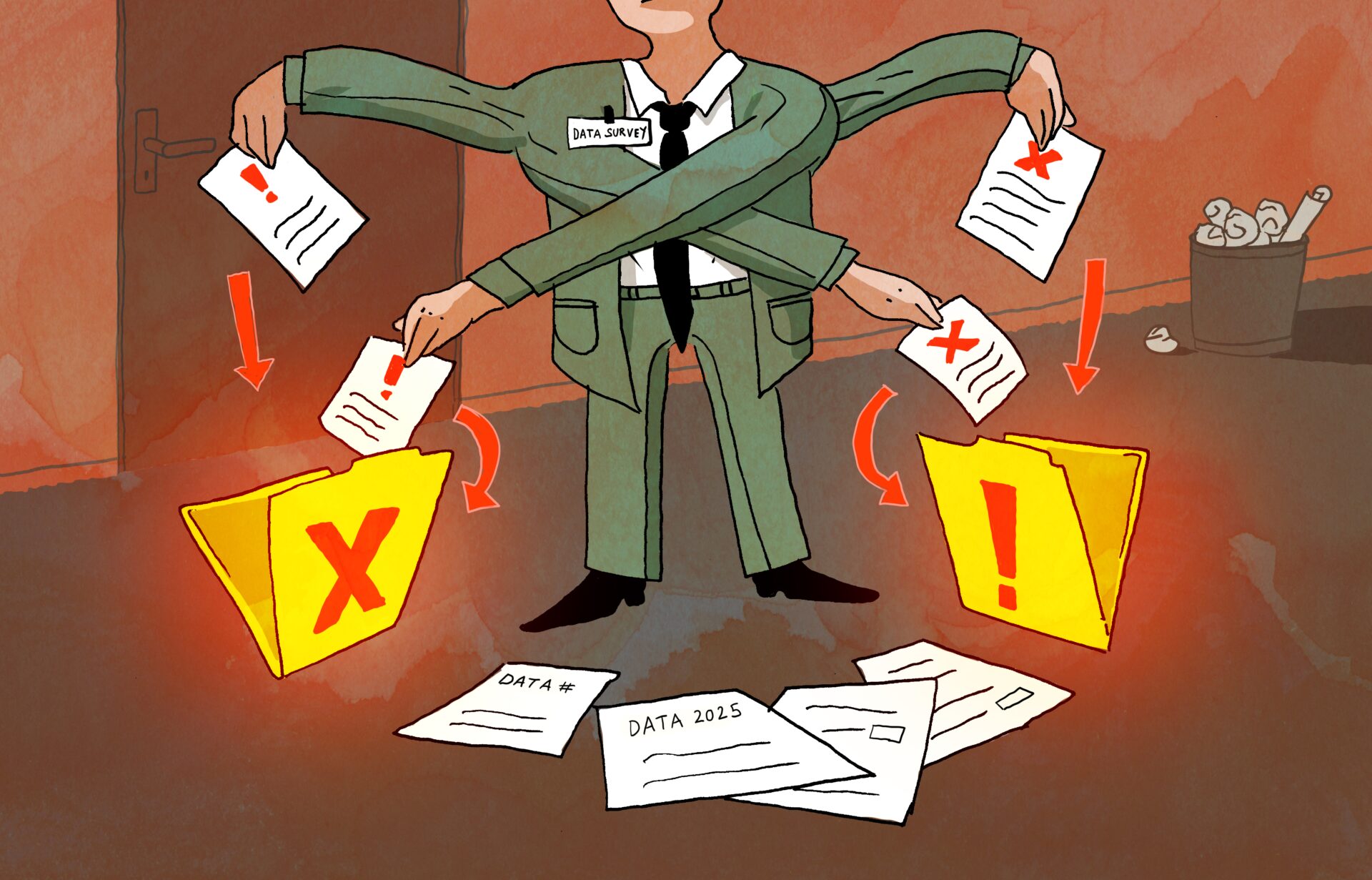
These 274 employees answered online questions about various topics, such as how often they had observed abusive behavior, what their own mental resilience was, and whether they planned to look for another job or already had started working somewhere else. All participants were required to complete the same questionnaire three times, with a one-month interval between each, to determine long-term effects.
Ultimately, this yielded a summary results table with 274 rows, one for each participant. The researchers posted this table on the Open Science Framework (OSF), a website where social science researchers often share data for reuse and transparency, in the context of Open Science.
Statistically impossible
That dataset ultimately formed the basis for the integrity complaint. When it became public that G. had been summarily dismissed, the complainants wondered whether he had acted with integrity in his scientific work. According to the report, they had already “noticed irregularities” in the way he handled data and had received “indications” of possible data fabrication at a previous employer.
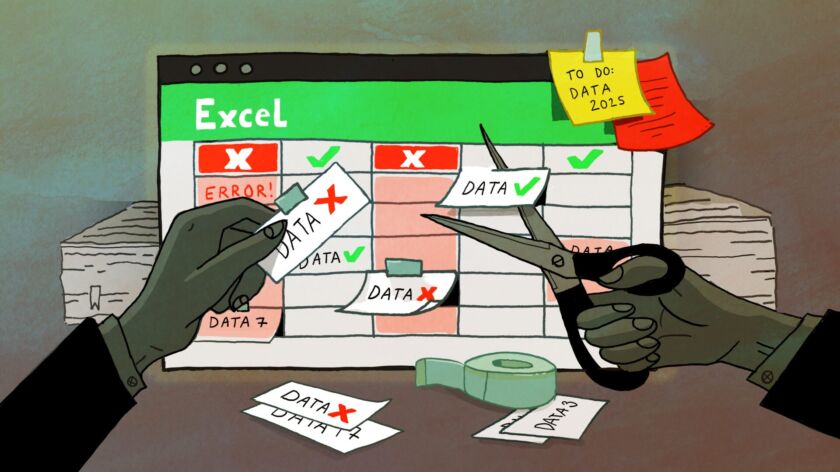
When the complainants examined the response tables on OSF, they saw that many numbers appeared multiple times. As many as 233 of the 274 subjects had values that were identical to those of another participant, they discovered. Statistically, it is almost impossible for this to be a coincidence, according to a calculation they performed.
Several columns from the dataset appeared to have been copied and pasted elsewhere, but then jumbled up.
Several columns from the dataset also appeared to have been copied and pasted elsewhere in the table, but then jumbled up. The report does not explicitly mention this, but from the publication it becomes clear that these likely involve numbers that quantify the participants’ resilience, a metric that is important for the article’s conclusions.
Original files cannot be found
The complainants strongly suspect that the research never actually took place, but that G. used data from a former student’s thesis (who is also a co-author of the article) and “duplicated” it. The average values in the publication closely resemble those in the thesis, which concerned an entirely different study and also involved a different number of subjects. The report was also found in the same departmental working group folder as the data uploaded to OSF. The integrity committee has “the suspicion that the research and the dataset from the master’s thesis may have served as inspiration for the fabrication of the dataset by the defendant.”
It does not consider proven that the thesis served as the basis for the data fabrication, however, because it could no longer locate the original data files—the completed questionnaires—anywhere. Not even in G.’s account of the survey software that was allegedly used – most likely Qualtrics, a tool G. mentions more often in other publications. Storing the original data is common practice, both for verifying results and, for example, to ensure the continuity of research after someone leaves the university.
During the integrity proceedings, G. denies that there was any intent involved
During the integrity proceedings, G. denies that there was any intent involved. Yes, there are duplicates in the data, but these are the result of human or technical errors, for example during the merging of the research data. A statistician whom G. asked to review the data (according to the complainants, a friend of his) is said to have confirmed this. Specifically, there was “a consistent, repeatable pattern in the dataset,” and no randomness.
‘Not convincing’
The committee does not find G’s defense convincing. The number of duplicated data points is too large for that, and there are too many inconsistencies in the duplicates. It also takes into account that the raw measurement data can no longer be found anywhere, an indication that they were ‘not collected in a scientifically correct manner.’ Finally, the integrity committee finds it difficult to believe that the authors themselves had not noticed the duplicates earlier, as they are quite conspicuous.
The Executive Board subsequently declares the complaint valid, notifies the authors and the journal, and initiates a follow-up investigation into other publications by G. It is noteworthy that other datasets that G. had uploaded to the OSF platform are no longer accessible, which makes it difficult to verify the corresponding publications. The reason, he writes in a PDF: a “serious and unacceptable breach of trust by a former employer. The misuse of these data represented a serious violation of open access principles.”
Personal relationship
To what extent were the co-authors aware of the issues in their article? That is difficult to determine. According to the integrity report, the complainants assume that G. acted on his own initiative and that the co-authors knew nothing about it. When asked for a response, eventually three of them reply. The fourth one – who is G.’s partner, as Vox was able to verify – did not respond to questions from Vox.
The second author of the article, who works at a foreign university, was surprised when he received a message from the integrity committee of Radboud University. “My understanding prior to this notification was that an error had been identified in the dataset and that the first author had proactively requested a retraction from the journal”, he writes in an email. “While this was extremely disappointing, I considered the decision (..) appropriate with maintaining scientific integrity.”
According to him, G. was solely responsible for the collection, handling, and analysis of the data. “My contribution to the paper was limited to co-writing the manuscript and refining its theoretical framework.”
Another co-author also emphasizes that they were unaware of the integrity investigation and wishes to remain anonymous. “I only heard about it for the first time when the university informed me of the outcome. I have nothing to do with this and was not involved in the data analysis of the publication. I am also not allowed to say anything more about it. The university has explicitly requested that I handle the information they shared with me regarding this matter in a confidential manner.”
I have no idea what happened to the data from my thesis
The third co-author who responded was the former student. They don’t wish to be named either and say they were unaware of the integrity procedure until the university emailed them about the outcome. “At first I thought it was spam. I have no idea what I’ve gotten into. It feels like I’m in the backseat of a car that’s veering off the road, but I can’t reach the steering wheel to prevent it or get out. I have no idea what was done with the data from my thesis, and wasn’t involved in that either. The university confirmed this as well. They say they hold only him responsible, but I’m now an unwanted victim.”
G. had only ever asked if the results of the master’s thesis could be used for a publication, but did not involve the former student in the writing process, even though the task division mentioned in the publication suggests otherwise. “I only heard about the publication after the article had already been published online. I don’t know the other co-authors, I had never been in contact with them.”
Cited at least ten times
What happens next? The publication in the Journal of Business Research has not yet been retracted, although the university has forwarded the findings of the integrity investigation. G. also stated during the investigation that he had already asked the journal himself for a retraction when he heard about the—in his view, unintentional—duplications in the accompanying dataset. He found it “vindictive” and “punitive” that an integrity complaint was nevertheless filed against him, according to the integrity report.
Nor does the publication carry a so-called “expression of concern”, a label that warns readers that the content of an article may be unreliable. Since its publication in February 2025, the article has already been cited at least ten times by other publications.
The journal’s editors-in-chief, including professor Mirella Kleijnen (Vrije Universiteit), did not respond personally to emails or phone calls. Publisher Suzanne Abbott stated on their behalf that Elsevier, owner of the Journal of Business Research, will issue a response in due course.
Incompetence
G. did not respond to multiple requests from Vox for comment. In his opinion piece from last month, however, he writes about academia: “Errors are no longer interpreted as human or epistemological; they are interpreted as suspicious. A flawed analysis is not a mistake, but evidence of incompetence, bias, or worse. A failed replication is not informative, but an accusation.” What happened at 9:48 PM on May 2, 2024 remains unknown for now.
Immediate dismissal
Even before the integrity issues with his research data came to light, G. was already dismissed with immediate effect, as is stated in the report by the Commissie Wetenschappelijke Integriteit (CWI). According to the report, the dismissal was followed by a settlement agreement, and the labor dispute concerned “invoice fraud”.
In 2025, an employee of the social sciences faculty was dismissed, says Dean Evelyn Kroesbergen when asked. She refuses to confirm whether it was G. She also declines to address other questions about the investigation. Immediate dismissal is not common. In the years 2023, 2024, and 2025, it happened only once at Radboud University, says a university spokesperson.
According to the national government, grounds for immediate dismissal include serious misconduct at work such as theft, fraud, incompetence, or refusing to work without good cause.
During the integrity proceedings, G. suggested that the investigation would violate the settlement agreement. That agreement refers to a “final discharge,” an arrangement stipulating that no further claims can be made against each other. The CWI, however, argues that “a complaint regarding scientific integrity” cannot be considered a claim.
G. now works for an organization outside academia. However, he hasn’t completely left the academic world behind: he still appears affiliated with a foreign university and serves as an editor for an academic journal.