Article with manipulated data by dismissed psychologist retracted
-
 Illustratie: Ivana Smudja
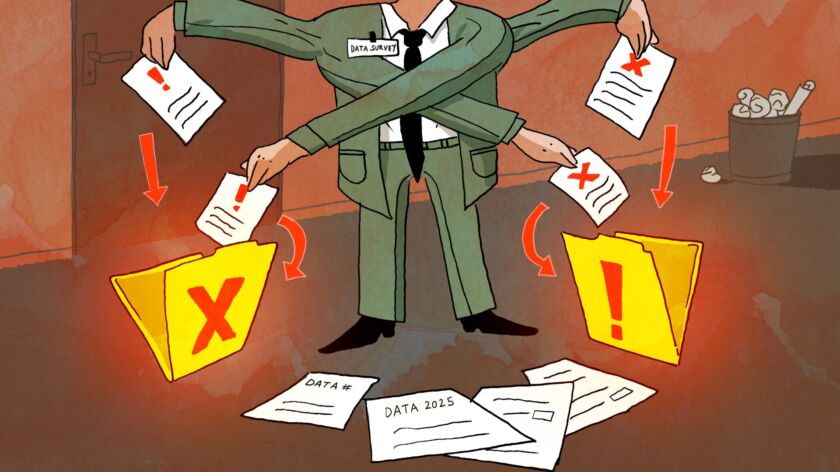
The Journal of Business Research has retracted the scientific publication by the dismissed psychologist G., which used manipulated data. Doubts about that data were the basis of a scientific integrity complaint that the university’s Scientific Integrity Committee (CWI) recently ruled to be well-founded.
“Following publication, significant issues were identified within the data file used for the analyses reported in the article,” the journal writes in an explanatory note, known as a retraction note. “These rendered the results unreliable.”
As the corresponding author, G. had himself reported the problems with the data to the journal. This occurred after complainants had discovered the errors and reported them to G. and his co-authors. As far as G. was concerned, the matter was thereby sufficiently resolved, according to the anonymized CWI report, but the complainants subsequently filed an integrity complaint.
They had discovered that a significant portion of the dataset consisted of data that had been copied and pasted, with no reasonable explanation for this. As many as 233 of the 274 participants had values that were identical to those of another participant in the survey that formed the basis of the publication.
Co-authors
When this committee confirmed the data fraud, the editors of the Journal of Business Research also lost confidence in the article’s conclusions, they write, and decided that the article had to be retracted. That has now happened, “at the request of the authors and Editors in Chief.”
The retraction note emphasizes that the co-authors were “not aware of, and did not contribute to” any matter regarding data collection and analysis. “The corresponding author (G., ed.) takes full responsibility for any issue associated with these steps.”
Data Manipulation
In 2025, G., an associate professor in the Work, Health, and Performance research group at the Faculty of Social Sciences, was summarily dismissed for invoice fraud. It later emerged that the former researcher had cut, pasted, and manipulated research results in an academic article.
A committee at Radboud University ruled that a complaint regarding data manipulation and/or fabrication against the former occupational and organizational psychologist G. was well-founded. Previous articles by the former employee will also be reviewed.
After his dismissal from Radboud University, G. still was editor-in-chief of a journal in management sciences. According to Sage Publishing, which publishes the journal, he resigned from this position.