Co-author describes how fraudulent Radboud scientist fabricated peer review process
-
 Illustratie: Ivana Smudja
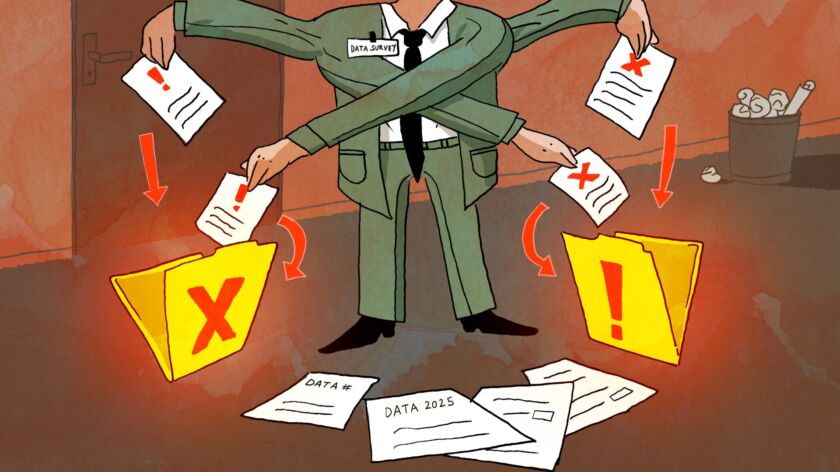
The scientist dismissed from Radboud University fabricated an entire peer review process, according to one of his co-authors, in order to get an article published in the journal where he himself served as editor-in-chief. He made it appear as though genuine scientists had reviewed the paper.
Dismissed associate professor Yannick Griep staged a complete peer review process to get at least one of his own articles published in the scientific journal of which he was editor-in-chief at the time, according to American organizational psychologist James Lemoine, writing on LinkedIn. Lemoine is one of the co-authors of the article in question and works at the University at Buffalo in New York.
The American associate professor describes on the platform how Griep operated. He is sharing his story to clear his own name and those of the other co-authors, he writes. The article in question, published in the journal Group & Organization Management (GOM) in 2024, has since been retracted at the request of the authors, as have seven other articles bearing Griep’s name.
A tip from a friend
Lemoine received a tip from a friend that the peer review process “may not have been quite what it seemed,” as he writes in his LinkedIn post. He then began his own investigation.
At scientific journals, it is standard practice that when an editor-in-chief wishes to publish an article themselves, a fellow editor handles the peer review process to prevent conflicts of interest. In peer review, usually two or three fellow researchers assess an article before it may be published in a journal. It is an important mechanism for ensuring scientific quality. Griep, who was editor-in-chief of GOM at the time, told Lemoine he had indeed delegated this task.
The fellow editors were unaware of the article’s existence
But Lemoine’s inquiries revealed that the fellow editors who were supposedly responsible for overseeing and ultimately approving the article had never been asked. Moreover, they were unaware of the article’s existence and had therefore given no approval whatsoever.
The scientists enlisted to assess the article’s content and provide feedback — the peer reviewers — turned out to hold fake accounts at GOM.
“A major ethical violation”
Lemoine writes that he then confronted Griep with his findings and asked for an explanation. The response he received was vague. “He vaguely responded that maybe he had handled the paper himself and done everything described above, but only for the purpose of expediting the publication of more quality articles in the new GOM Now journal section,” Lemoine writes. “I replied that if an author of a paper also acted as the handling editor, making all of the publication decisions, this seemed like a major ethical violation deserving of a retraction.”
Once the American researcher had assembled his evidence against Griep, he decided to submit a formal retraction request himself. Months passed before he received confirmation that the journal would indeed proceed with the retraction. Publisher Sage retracted not only the paper Lemoine co-authored, but also seven other publications in GOM bearing Griep’s name.
“As the peer-review process was administered by the former Editor in Chief, who is also the co-author of the articles, the objectivity of the peer-review process has been compromised. In line with COPE guidelines, the articles have been retracted,” Sage stated on its website. COPE stands for Committee on Publication Ethics, an international body that sets guidelines for ethical conduct in scientific publishing. Sage is a member. “The retraction relates to the underlying review process and no determination has been made regarding the scientific content of the articles,” the publisher added.
Manipulated data
Griep had previously been found to have fabricated or manipulated data in at least one article in another journal, a conclusion reached by the Committee on Scientific Integrity. An investigation by Radboud University into other publications by Griep is still ongoing. Concerns about his scientific integrity had also existed at the universities in Belgium and Canada where the occupational psychologist previously worked, as Vox reported.
At Radboud University, he was dismissed with immediate effect in 2024 for invoice fraud. After he challenged this dismissal in court, a settlement agreement was reached.
Publisher Sage does not name Griep — who served as editor-in-chief of GOM from April 2022 to March 2026 — in its statement about the retracted articles. He is, however, the only author appearing on every one of the publications. His former co-author James Lemoine also refrains from naming him explicitly.
“Betrayal of trust”
In his LinkedIn post, Lemoine writes that despite everything, he is grateful to his unethically acting colleague for sending an email to the publisher acknowledging that Lemoine was uninvolved in and unaware of the fake review process.
“I considered the editor-in-chief a friend and I will share that this feels like a major betrayal of trust,” Lemoine writes. “I hope he finds a better path forward once the dust settles on this. None of us are perfect, but one of the greatest things about us is our potential to learn from our mistakes and become better people.” In the comments under his post from Tuesday, other scientists praise Lemoine for his openness and integrity.
Lemoine told Vox that he saw no need to comment on his own post. In response to questions from Vox, a Sage spokesperson referred to the online statement regarding the retracted articles. Yannick Griep has remained silent on the matter.