Summer interview (3): Jan Mustafa fled Syria — in Nijmegen, his main goal is helping others
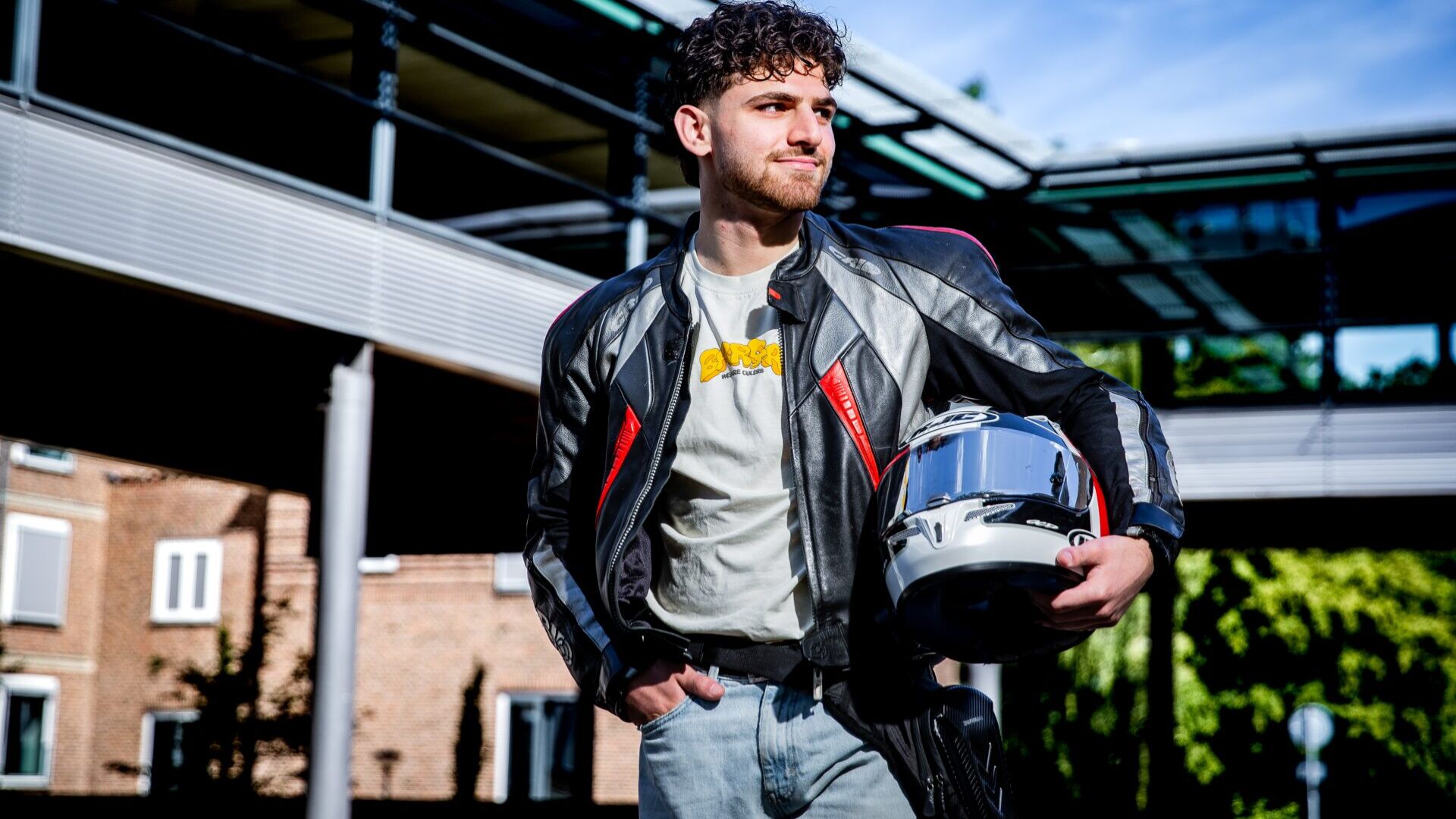
Six years ago, he had to flee Syria after criticising the government. Today, Jan Mustafa (24) is training to become a doctor, speaks fluent Dutch, works as an interpreter, and still takes his motorcycle out for a ride now and then. Improving himself and helping others is what gives him energy. ‘I’m critical of myself, but certainly of others too.’
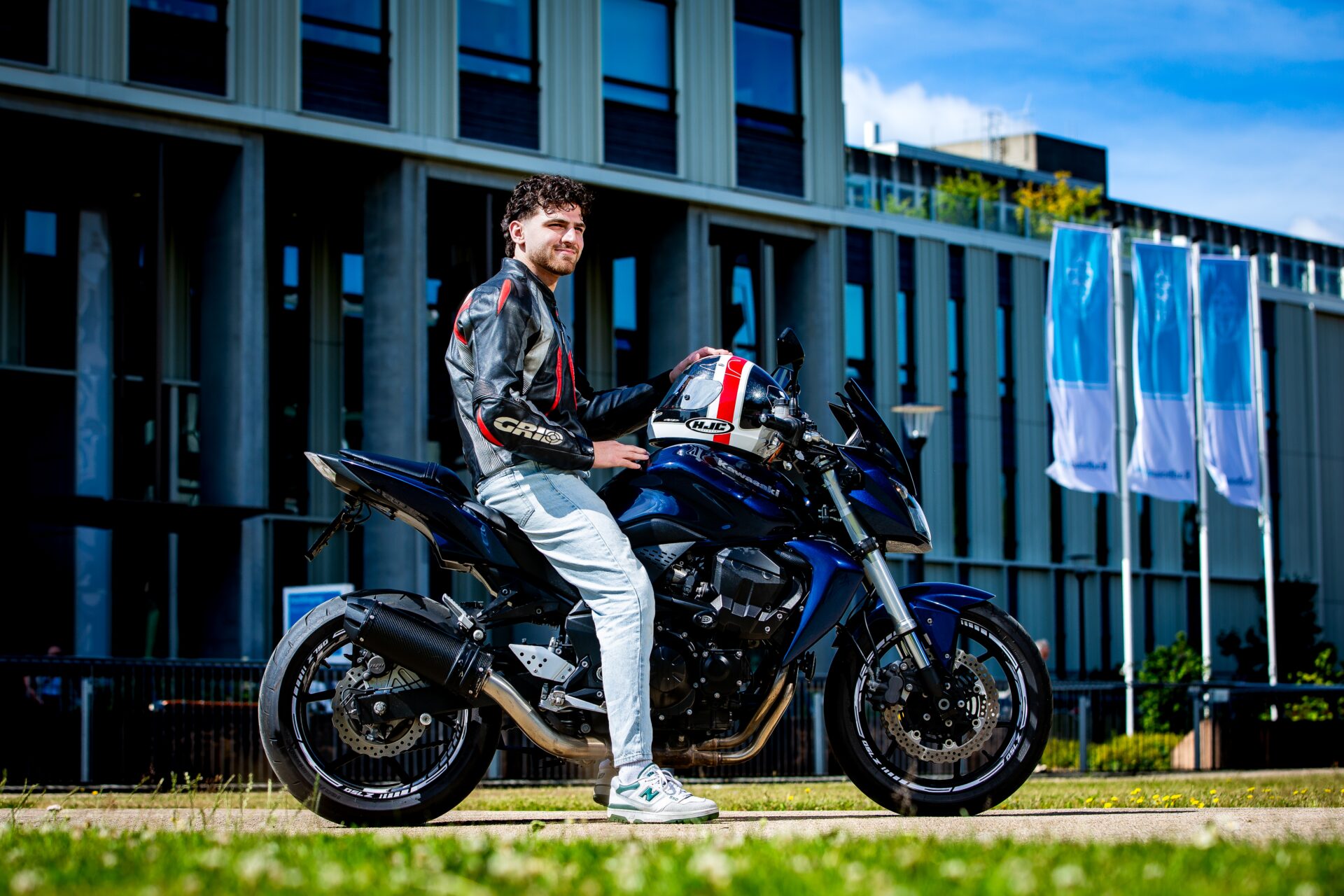
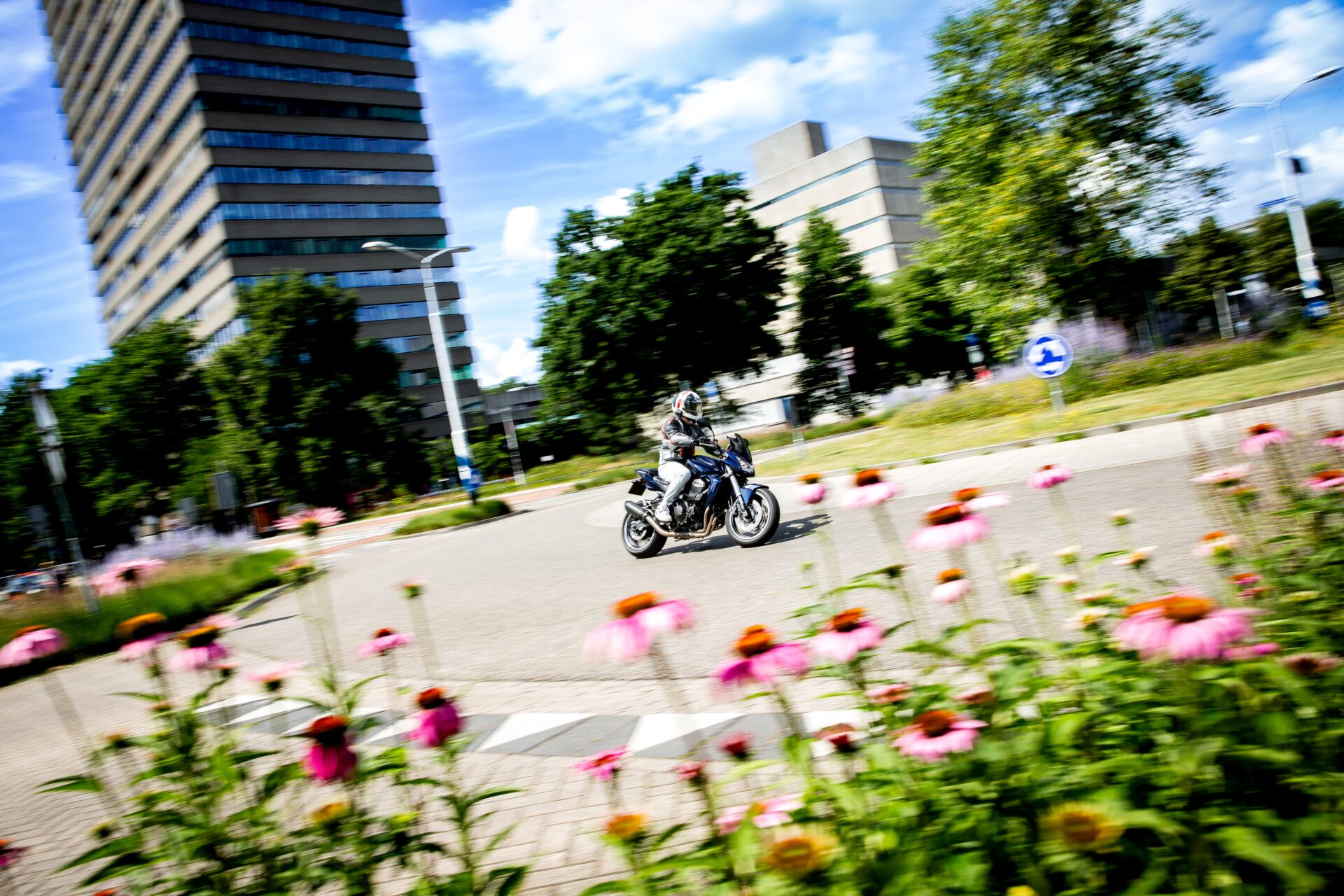
A rumbling sound echoes between the buildings on Linneausplein. The exhaust of a Kawasaki Z750. Dark blue metallic coating, a sizeable engine — good for 120 horsepower. At a gentle pace, the two-wheeled machine rolls onto the square.
The rider dismounts. Gloves off. Helmet off. The smile of 24-year-old Jan Mustafa appears.
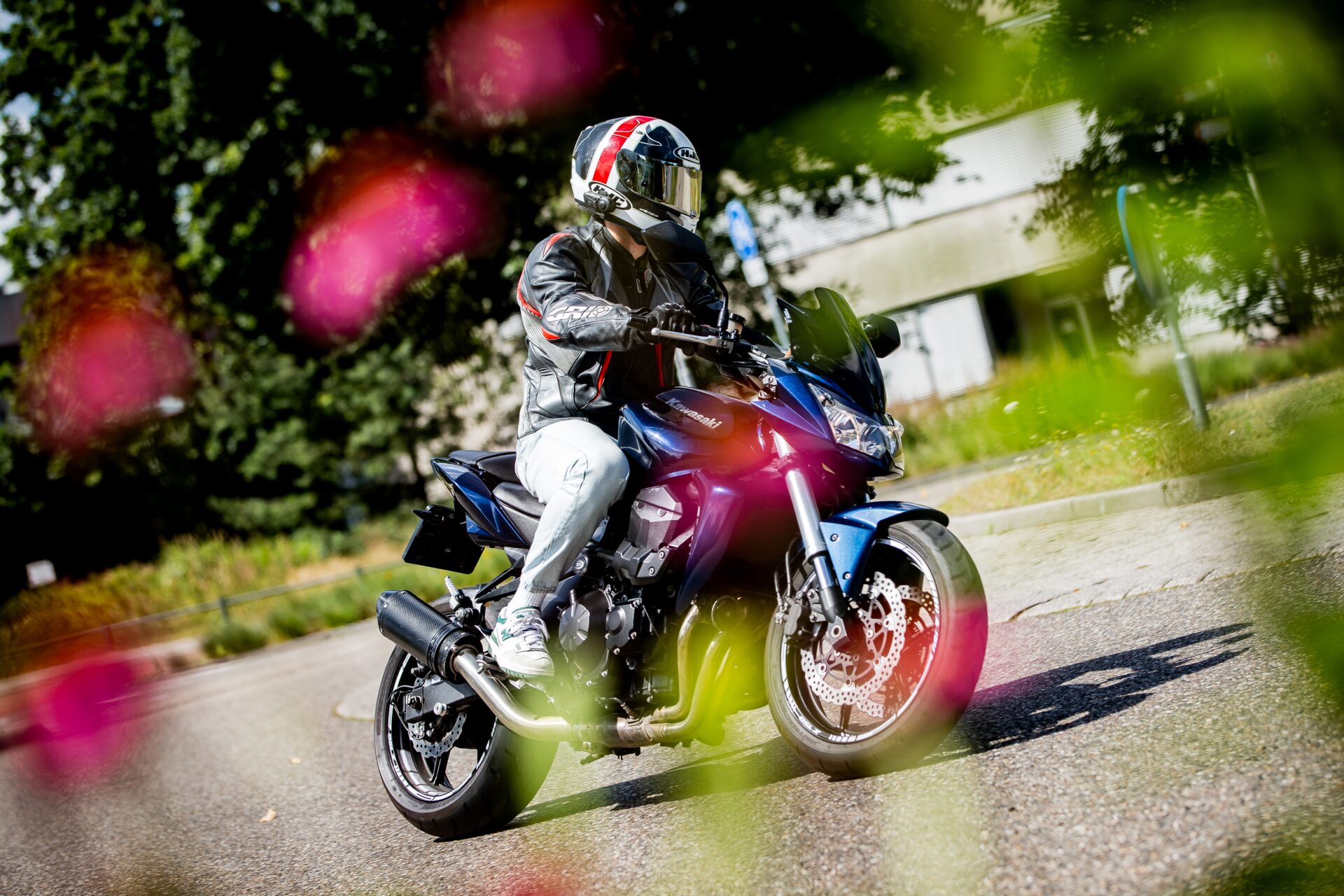
‘I don’t like that banging sound of the exhaust’, says Mustafa as he proudly shows off his new motorcycle. ‘That’s why it has a good decibel killer on it. I actually never cared much for motorcycling — I just thought it was dangerous. But about two years ago, I suddenly decided to get my licence anyway. I don’t really know why, to be honest. But it’s truly wonderful for clearing your head.’
Always in good spirits
It’s typical of how the 24-year-old Kurdish Syrian is wired. Always in good spirits, open to something new. A challenge for himself, or a way to help someone else.
Sitting on a bench on Linneausplein, he talks about his life. About his sudden flight from Syria as an 18-year-old. About his time in Dutch asylum seekers’ centres (AZC). About how he learned the language and was determined to study Medicine.
Behind us, in the Linneaus building, he took a test in 2021 to be admitted to a tailor-made programme to enroll in Medicine. At that point, he had been in the Netherlands for just over six months. The building holds great symbolic value for him. ‘I remember how I got off at the bus stop here. I had travelled by public transport from the asylum seekers’ centre near Deventer and didn’t really know what to expect. I was impressed by the campus.’
Biography
Name: Jan Mustafa
Born in: Afrin, Syria (2002)
Study: Medicine
Work: Runs his own business as an interpreter. Speaks Kurdish, Arabic, English, and Dutch
He starts to laugh. ‘I had studied far too well — it was only a test to see whether I could take part in the tailor-made programme. I had already worked through entire medical textbooks in preparation. How was I to know — I thought I had to know everything already.’
Final destination unknown
Mustafa’s journey to the Radboud campus began in 2020 — though at that point he didn’t yet know what his final destination would be. Mustafa has Kurdish roots and, before he was forced to flee he lived in Afrin, a city about 60 kilometres north of the Syrian city of Aleppo.
He had criticised the Syrian regime on social media. It soon became clear that the government had him in its sights and that Mustafa had to leave the country. A human trafficker helped him across the border, and after several weeks in Turkey and Greece, Mustafa — an eighteen-year-old kid — finally arrived at the COA registration centre in Ter Apel.
‘I’m always in favour of a good discussion. But there are limits — there was no talking to this man’
‘That wasn’t easy’, he recalls. ‘You’re 18, completely alone, and you have to share a room with three others. That took some getting used to. It was a period full of uncertainty anyway: after Ter Apel, I temporarily stayed in asylum seekers’ centres in Budel and Schalkhaar, as well as other places.’
‘I also had very few people to share my troubles with. I knew my parents in Syria were already worried about me. And they were in an unsafe situation there themselves. I wasn’t going to whine to them about having to share my room here.’
Besides, he was simply glad to have ended up in the Netherlands. After an intake interview, he had understood that he stood a good chance of getting a residence permit.
In Syria, he studied Medicine — his parents also work in healthcare — and he immediately resolved to continue pursuing that dream in the Netherlands.
‘At the asylum seekers’ centre in Deventer, I did everything I could to learn Dutch quickly. Because I knew that as a doctor, I would need to speak the language well. I was studying about six or seven hours a day. There wasn’t much else to do anyway: I wasn’t yet allowed to work or study while awaiting my asylum procedure. And I didn’t want to spend all day being bored either. It may sound strange, but it was precisely the strength to persevere despite everything that gave me renewed energy.’
Kurds in Syria
Kurds live mainly spread across several countries in the Middle East, including Turkey, Iran, Syria, Armenia, and Iraq. About 90 percent of them are Muslim; there are also many Yazidis.
An estimated two million Kurds live in Syria. That makes them around ten percent of the population and the country’s largest ethnic minority. The Kurds live mainly in a region in the northeast of the country. During the Syrian civil war, Syrian Kurds established their own autonomous de facto state there, called Rojava. Kurds are oppressed in Syria: they are not allowed to speak Kurdish everywhere, and certain Kurdish books are banned. They are also only allowed to have Arabic names.
In addition, the Kurds fear various militias that actively seek to exterminate them. They were murdered or captured by IS, for instance. During the Syrian civil war, many Kurds fled the region, heading for Turkey and Europe.
The way Mustafa talks about it is light-hearted, almost indifferent. As if fleeing to a completely unknown country is the most normal thing in the world. For him, it is.
The way politicians talk about asylum seekers hurts Mustafa. ‘You hear a lot of stories about the thousands of asylum seekers coming this way who are supposedly a problem for society. But people forget to look at the individuals behind those numbers. These really are human lives — everyone has a story.’
Incident
But, he adds with nuance, he has also seen things that are problematic. ‘I’m critical of myself, but certainly of others too. I’ve seen people around and thought: “You’re putting the reputation of other refugees at risk with your behaviour”.’
As an example, he mentions an incident with a man who had also fled Syria. ‘This man said the filthiest things to me when he found out I was a Kurd from Afrin. A few years ago, our city was occupied by Islamic fighters and the Turkish army. This man referred to that and proudly said that we were lesser people and that he was a good Muslim.’
The medical student shakes his head. The smile has vanished from his face.
‘And that was only one of the incidents with this man. The most absurd part of the story is that I ran into him again about two years ago in a club in Arnhem, when I was out for the evening. So he’s still walking around here, despite behaviour like that.’
‘I’m always in favour of a good discussion. But there are limits — there was no talking to this man. How can you treat another person like that, purely on the basis of their background? People like that ruin it for the many others who are here with good intentions and want to build a future.’
People should be a little more aware of the impact of their words, Mustafa believes. ‘When I see how politicians in the House of Representatives talk about refugees. Come on, man — you’re a role model when you’re standing there. If you as a politician are already using such strong and polarising language, what do you expect from people on social media? Things are ten times worse there.’
‘The funny thing is that it’s often precisely the people who shout the loudest online who then get along perfectly well with their Moroccan or Turkish neighbour. Once you know each other a little, the cultural differences suddenly aren’t a problem anymore.’
Medicine
Back to his academic ambitions. Because even though by 2023 Mustafa spoke fluent Dutch, had his residence permit sorted, had a job, and even had his own place in Elst, getting into the Medicine programme turned out to be far from straightforward.
At the time, the selection procedure for Medicine consisted not only of a knowledge test — which Mustafa passed with ease. There was also a so-called situational judgement test that carried equal weight, in which you are asked questions about specific situations in the hospital. And that’s exactly where things went wrong. Because the culture here in the Netherlands is a lot more direct than in Syria, as Mustafa quickly discovered.
‘Imagine a Kurdish patient sitting in the consultation room and you, as a doctor, being very direct right away — that’s not the best way to get something across either’
‘It makes no sense’, he says. ‘If you have Dutch parents, it’s much easier to pass that test, especially if they work in the medical field themselves. What’s more, there isn’t just one correct way to respond. People in the Achterhoek already do things differently than in the Randstad, or in South Limburg. Or imagine a Kurdish patient sitting in the consultation room and you, as a doctor, being very direct right away — that’s not the best way to get something across either.’
He challenged the selection procedure, and his case gained national attention. Less than two years after arriving in Ter Apel, he even found himself in the House of Representatives, arguing that admission for students should be made fairer. ‘It didn’t do me much good at that moment, of course, but I mainly hoped it would improve the chances of others in the same situation.’
Sad family news
The legal battle ultimately paid off. In the summer of 2024, Mustafa was told he could start the programme in September. And Radboud University later also changed the admission requirements for the Medicine programme — one of the few universities in The Netherlands to do so.
Mustafa has now just finished his second year; after the summer, he will start the final year of his Bachelor’s. The fact that he is still right on schedule with his studies is something of a small miracle. In January, in the middle of his exam week, he received sad family news from Syria: his cousin and uncle had both been shot dead in the hospital in Aleppo where they worked — because of their Kurdish background.
‘In a hospital, where they help everyone, regardless of background…’ He cannot wrap his head around it.
‘My cousin was fifteen years older and I looked up to him. He used to take me along to the hospital where he worked as a pharmacist. He was the very reason I wanted to go into medicine myself.’
Mustafa deals even with this loss in his characteristically undaunted way. He tries not to dwell on it, but to draw from it the motivation to keep going. He passed all of his exams in January, without any resits. And he isn’t worried about his latest exams either — he’s still waiting for the results. ‘First a few weeks of holiday. To Spain with my little brother, and then on to Italy with my girlfriend. I could definitely use it.’
Ultimately, he hopes to specialise as a heart surgeon. Or perhaps a neurologist or cardiologist after all. ‘As a surgeon, you only come into the picture when a procedure is needed, and after that you’re done again. It also seems very interesting to me to guide a patient through an entire process. Neurologists and cardiologists do that much more, because you also run outpatient clinics. That’s why I’m already looking forward to my clinical rotations (coschappen in Dutch, eds.), when I can experience what the work is like in practice.’
Working as an interpreter
Anyone who thinks Mustafa spends all his time after lectures buried in his books is mistaken. He does study a lot, but he also exercises regularly, works as an interpreter, is in a relationship, and tries to see his family — who have since come over to the Netherlands — on a regular basis.
Where does he find the time? He starts laughing at the question.
‘Sometimes I have no idea either. But helping others is exactly what gives me energy. Especially as an interpreter, I sometimes end up in really difficult situations where you can genuinely make a difference for people. I speak Kurdish and Arabic, which comes in handy when people don’t speak Dutch or English. Think of court cases or police interrogations, for example. I also regularly work as an interpreter at Radboudumc, when there are patients who don’t speak Dutch. And that’s where my medical knowledge comes in very useful again.’
‘Because it says Jan, many people expect a somewhat older, Dutch interpreter’
His work as an interpreter provides him with plenty of funny anecdotes. ‘My first name is a traditional Kurdish name — you pronounce it djan. But because it says Jan, many people expect a somewhat older, Dutch interpreter. Especially since I speak virtually accent-free Dutch. So they are surprised when they suddenly see a young foreign man walking in.’
‘A while ago, I helped a law firm with translation into Kurdish. Afterwards, the man from the firm asked me: “Jan, where on earth did you learn to speak such fluent Kurdish?” So I explained to him that it’s my first language and that I’ve only been living in the Netherlands for a few years.’
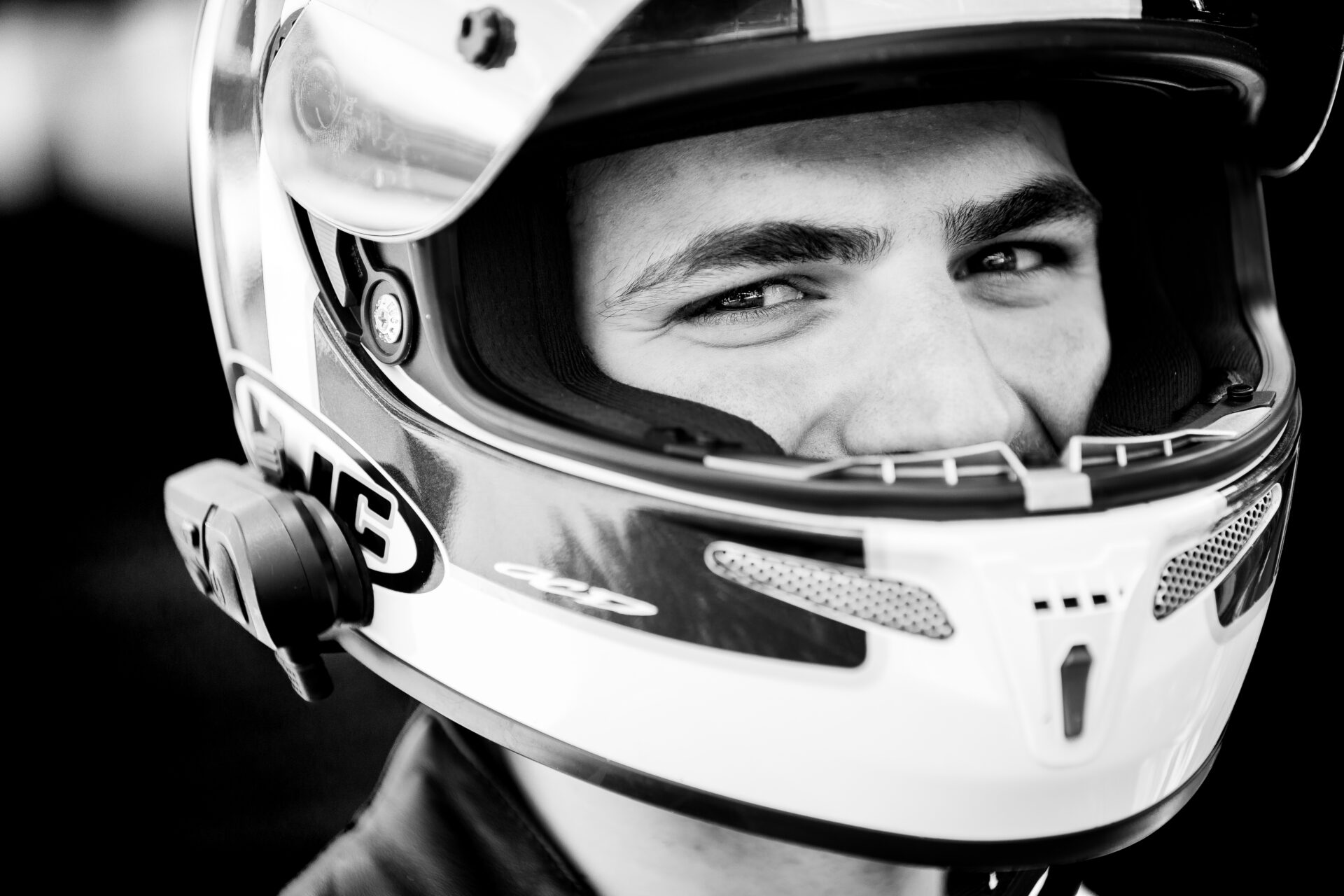
He prefers to ride his motorcycle in the Achterhoek. It’s nice and quiet and green there. The stress melts away all by itself. He puts his helmet back on and rides a few laps around Erasmuslaan and Heyendaalseweg for the photographer.
One more time around the roundabout. The sound of a roaring exhaust. And off he goes.
Our other Summer Interviews:
1. Spinoza Prize winner Karin Roelofs: How a tiny mouse sparked a major study on stress
2. Communication scientist Rebecca de Leeuw on resilience and her son, who was born deaf
4. Wheelchair basketball star Bo Kramer (27): ‘As an elite athlete, you have to love pushing yourself to the limit’
5. Sander Leeuwenburgh, the dentistry professor turning full-time pianist
6. Hans de Kroon, the ecologist who explained why you no longer need to clean bugs off your windshield (because there are hardly any left)
7. Professor Paul van der Velde: ‘People often think I’m a Buddhist’

Iprefernotto schreef op 18 juli 2026 om 10:57
Loves to help people by translating for them, but also has a business for translation. He is defnetnly well intergrated.