Summer interview (4): Wheelchair basketball star Bo Kramer (27): ‘As an elite athlete, you have to love pushing yourself to the limit’
-
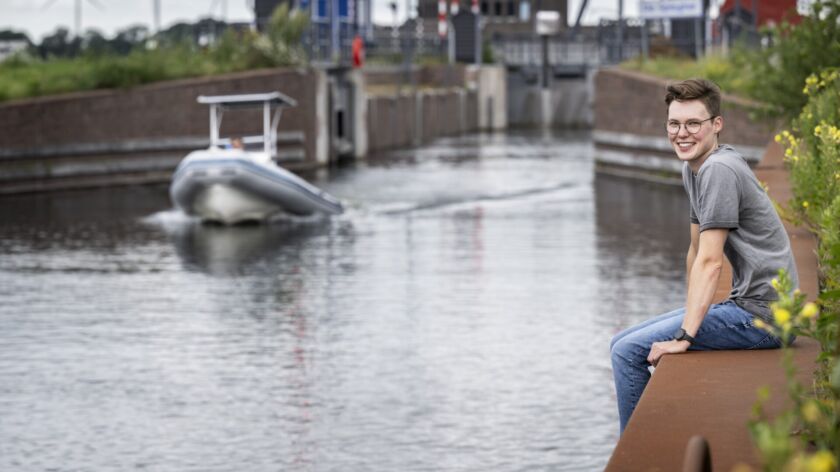 Bo Kramer in Zeewolde. Foto: Bert Beelen
Bo Kramer, a master's student in Biomedical Sciences, is among the world's leading Paralympic wheelchair basketball players. She will compete at the World Championships in Canada this September, and in January she will begin her PhD research. ‘When I was fifteen, I spent an entire year doing nothing but playing basketball. It drove me crazy.’
It is a quarter to seven in the morning and wheelchair basketball player Bo Kramer (27) is on the bike. Not outside, but inside, in the windowless attic of her newly built home on the edge of Zeewolde, where the wind howls past the roof tiles. Today (2 July) is one of her few days off this summer. For the past eight months, the master’s student in Biomedical Sciences did a full-time internship at the Princess Máxima Center for pediatric oncology. Tomorrow her training begins for the IWBF World Championship, in Canada in September. Half an hour of cycling to go, then an hour and a half of strength training.
Since Kramer joined the national team in 2014, the Dutch women’s wheelchair basketball squad has dominated the international stage, with five European titles, two World Championship golds and two golds at the Paralympic Summer Games. The Paralympic final in Paris was the hardest match of her career, she says, as she lifts the gleaming medal out of its box. ‘I was extremely nervous and insecure. You try shooting a ball through a hoop with trembling hands. It can’t be done. That ball flew everywhere. I thought: what the fuck am I doing?’
‘Normally I score about twenty points a game. After the first half I had two. During halftime I completely lost it at myself. “You’re damn well going to pull yourself together now. There are thirty thousand people in the stands and you’re sitting there playing like a sack of potatoes. Show them what you can do!” Then I scored thirteen points in the third quarter, and thirteen again in the fourth. I find it fascinating how you can rev up the collaboration between your body and your brain. Even when I’m fit, I can still play terribly if my head isn’t in the right place.’
Kramer grew up in a sporting family. Her parents played volleyball in the top national league. ‘On Saturday mornings my twin sister and I were dropped off at the sports hall. I was a cheeky kid; football was my outlet. But I only really came to appreciate sport once it was no longer possible.’
At the age of ten, after an injury, a tumor was discovered on her right shinbone. It took nine operations to bring the bone cancer under control. For five years she sat on the substitutes’ bench of her own life. ‘I grew up fast. I cried for one night; I thought I was going to die. But once it became clear it wasn’t a ferociously aggressive form, a switch flipped. Right, then I’m going to get better too. I was happy whenever I could go to school, and I found the operations interesting. I got to keep a piece of the tumor, and the plate that had been in my shin. After my big operation I had to learn to walk again. I wanted to do the primary school leavers’ musical standing up. And I did. As soon as I walked offstage, I quickly sat back down in my wheelchair in the wings.’
Did you feel no fear or grief in those years?
‘I switched that off completely. You can be very scared and very sad, but whining or having opinions about it serves no purpose. If you want to get better, you have to keep going — I learned that the hard way. I always said the illness hadn’t affected me much, but eventually you hit a wall and discover you did pick up a trauma after all. Because things happened in the hospital that were not okay.’
‘My entire shinbone had been removed and replaced with my left fibula. The day after the operation — I hadn’t moved an inch, because I was in enormous pain — the doctor comes in and starts cutting off the bandage. I screamed the whole hospital together. My mother fainted. In that moment they took away my autonomy completely. They didn’t listen to my screaming and just carried on. Ever since, a switch has been flipped inside me. I will never give away that autonomy and control again.’
‘My trust in my body took a beating too. Some tumor cells were left behind, and I’ve always found that a frightening thought. By doing sport and living as healthily as possible, I make the chance of getting sick again as small as possible — in my head, at least.’
After your final operation, did you think: I’m going to spend my life in a wheelchair?
‘No, the doctors were convinced I wouldn’t be left with any impairment. But I was in so much pain. Since my operations, my ankle can only move up and down. Rolling my foot through a step is difficult. Able-bodied sport was no longer an option.’
At the Paralympic Talent Day you discovered wheelchair basketball.
‘It was love at first sight. It’s a fast game, you’re allowed to ram and crash into each other a bit; sometimes people and wheelchairs go flying across the court. At fifteen I went to the elite sports program at Papendal.’
You’ve been in the business for twelve years now. As a Paralympic athlete, do you lead a different life from Olympic athletes?
‘No, we get the same salary and training facilities as an Olympic athlete. The biggest difference is that in Paralympic sport there is less competition and less turnover. In theory, it’s easier to reach the top. If I quit, there aren’t six more Bo Kramers waiting in line to replace me. That means you sometimes can’t share a court with the very best players. But you still have to function as a team, so if you manage that, it’s a beautiful thing.’
Do you feel you’re treated differently from an able-bodied athlete?
‘There are people who say: what you do is even more impressive than Olympic sport. I think that’s bullshit. Who says you haven’t overcome adversity? All the complaining about the lack of media attention I find feeble too. How can we expect 18 million Dutch people to watch wheelchair basketball when they think people in wheelchairs are strange? It does look odd, doesn’t it? I’m convinced that once people know what wheelchair basketball actually is, they’ll think it’s incredibly cool.’
What should we know about wheelchair basketball?
‘First of all, that we don’t have an intellectual disability. Some people expect you to be practically drooling your way across the court.’
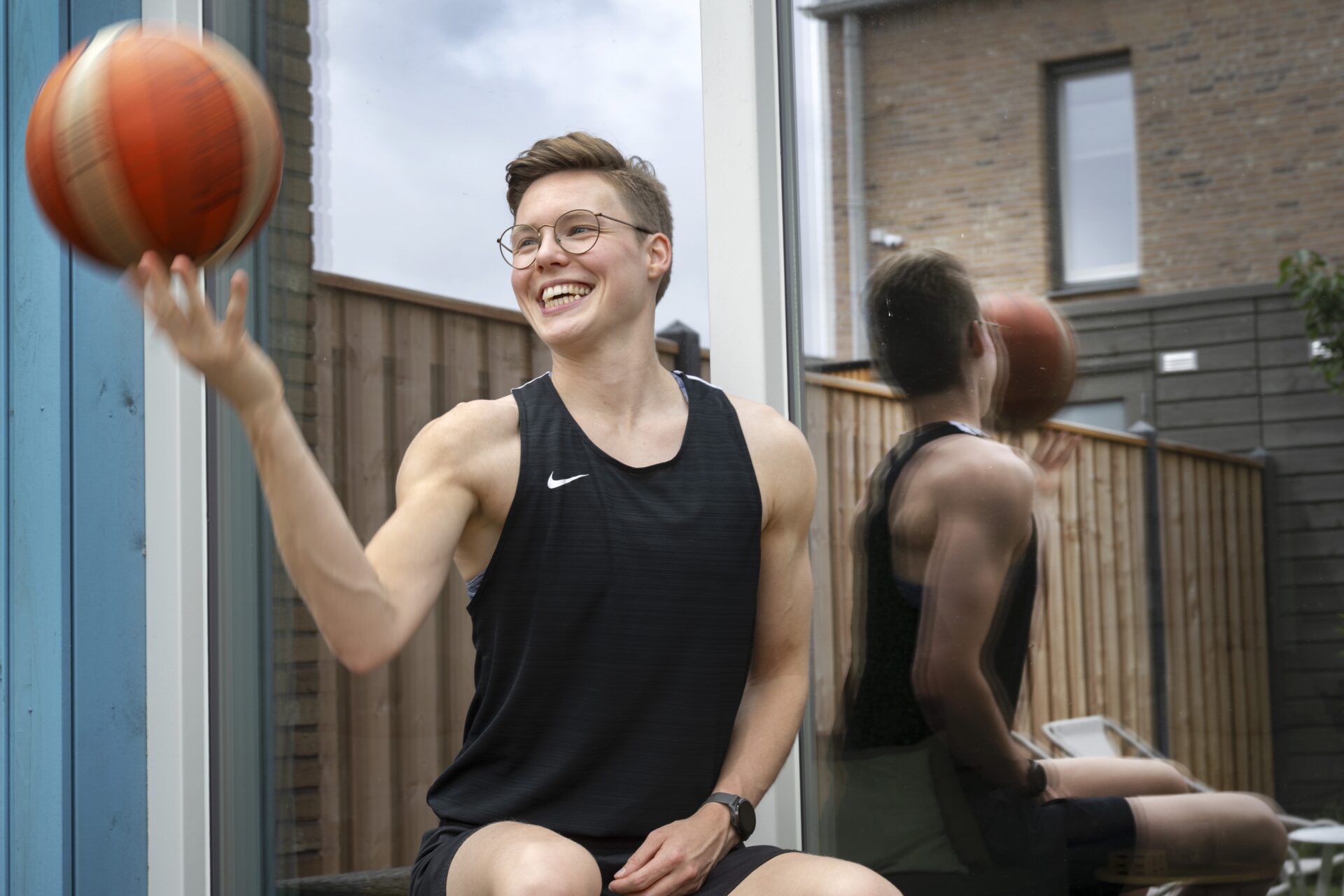
‘Secondly, wheelchair basketball is much more tactical. Able-bodied basketball is a very lateral game; you can easily walk around a person. In a wheelchair that’s harder, so we have to work together really well. But the game itself stays the same. The basket hangs at the same height and the court is the same size. We can do everything an able-bodied player can do.’
Deadpan: ‘Except dunking, because unfortunately my chair doesn’t have a spring.’
That wheelchair seems like friend and foe at the same time.
‘It is double-edged, yes. It’s my freedom in sport, but outside of it I find it an obstacle, because the world isn’t designed for people in wheelchairs. I can manage daily life without a wheelchair. An hour of walking is fine; an hour of standing gets harder. If I go shopping for a day I take the wheelchair, but that raises questions. People don’t understand that sometimes I can walk and sometimes I can’t. Or they start talking to my girlfriend about me.’
What do you do in a case like that?
‘Then I put them on the spot and say: “hello, I can speak for myself.” You don’t have to twist your neck just because I look different in my wheelchair than you do.’
In the attic, the student shows off the power rack where she trains every day. In this steel cage she sets the rules, but she also fights the pain every single day. ‘I’m broad up top, but my legs are thin. I can’t really train them, because of the pain. The plate in my leg lies very close to my skin. Still, I recently took up running. I always want to push the limit. My strength coach always says: “Bo, you’re not right in the head. You enjoy pain. If something isn’t heavy or doesn’t hurt, you don’t want to do it.”’
With a laugh: ‘I think that as a top athlete you have to get a kick out of destroying yourself, otherwise you won’t enjoy this.’
Is elite sport a way of coping with the consequences of your illness?
‘Partly, for sure, because in sport you can also just ram straight through things and feel very little. When I sit still I feel useless. I’ve had to learn to lie on the couch every now and then.’
Why did you have to learn that?
‘Because I crashed spectacularly, twice. The first time was in 2020, during corona. Tokyo was postponed by a year and we no longer trained together. The moment I exerted myself, I felt nauseous. Two years ago the same thing happened. With the help of psychologists I’ve learned to prevent myself from becoming overtrained. Was that fun? No. But sometimes I need to be slowed down.’
How does that show in your private life?
‘My schedule is sacred; I prefer to have everything fixed weeks in advance. When I ask my girlfriend on a Sunday what we’re having for dinner on Thursday, I can see her eyes roll. Sometimes the whole house has to be tidied up, because then it’s quieter in my head too.’
Kramer has been with her girlfriend for four years now. The paint in their newly bought house has only just dried; recently she shared their engagement on Instagram. International queer platforms celebrate her as a poster girl of the rainbow community. It’s not a role Kramer would choose. ‘Queer, lesbian — all those labels make my skin crawl. I’ve had to learn that it matters that there are people at the front of this movement. But if we simply let everyone do as they please, the whole Pride thing wouldn’t be necessary.’
You feel no need for the support of such a safe community?
‘Everyone around me is supportive. Everyone on the street thinks I’m a boy. When I walk hand in hand with my girlfriend, nobody bats an eye.’
The World Championship in Canada
In April 2026, the Dutch Basketball Federation terminated the membership of national team coach Gertjan van der Linden after fourteen players from the national women’s team filed a complaint against him over (sexually) transgressive behavior. Kramer worked with this coach from the age of fifteen, but she declines to comment on the impact of his behavior. ‘I won’t give him that satisfaction.’
In September you play at the World Championship in Canada. How do you rate your chances?
‘It’s going to be difficult, because the competition is closing in fast, especially from America. Now, with a new coach, we have to get used to each other. That’s fine, and we’re still very good, but everything does have to fall into place.’
In January your PhD research begins.
‘I’ve always known I wanted to build a career in society. Some athletes say: when I quit, I’ll fall into a black hole and be left with nothing. That won’t happen to me. Because I already know what my next dream is: going into childhood cancer research.’
‘It was recently discovered that there are micro-proteins that may be essential in the development of certain types of cancer. I’m going to study these little proteins in bowel cancer. We take tumor cells from a patient and turn them into a self-growing tumor that we can run tests on. Basically tinkering around with the DNA of those cells, so that in a few years I will hopefully have discovered a protein that could be a starting point for a therapy or medication.’
In the lab, you’ll soon be sitting still all day.
‘True, but I see my studies as elite sport too. You can’t slack off for a second. In the lab, you’re thinking every day about what the next step will be if something doesn’t work.’
Kramer bursts out laughing. ‘When I moved to Papendal at sixteen, I did nothing but play basketball for a year. It drove me up the wall; I went brain-dead. Analyzing matches really doesn’t require you to use your IQ.’
What won’t you miss when you quit elite sport?
‘That when I’m not feeling well or I’m exhausted, I still have to train. At important family moments, I’m never there. I notice it sometimes starts to grate on me, that I think: again? Where’s the challenge anymore? All that crap with the coach didn’t help either. At some point you think: it would be easier to stop. I want a little family; life goes on. Quitting at the top seems cool to me.’
Will you be able to handle it when your body slowly softens?
‘Some former athletes turn into those little balls of happy fat; I hope that’s not my future. I’ll keep doing sport, otherwise I’ll go stark raving mad.’
Our other Summer Interviews:
1. Spinoza Prize winner Karin Roelofs: How a tiny mouse sparked a major study on stress
2. Communication scientist Rebecca de Leeuw on resilience and her son, who was born deaf
3. Jan Mustafa fled Syria — in Nijmegen, his main goal is helping others
5. Sander Leeuwenburgh, the dentistry professor turning full-time pianist
6. Hans de Kroon, the ecologist who explained why you no longer need to clean bugs off your windshield (because there are hardly any left)
7. Professor Paul van der Velde: ‘People often think I’m a Buddhist’