Summer interview (6): Hans de Kroon, the ecologist who explained why you no longer need to clean bugs off your windshield (because there are hardly any left)
-
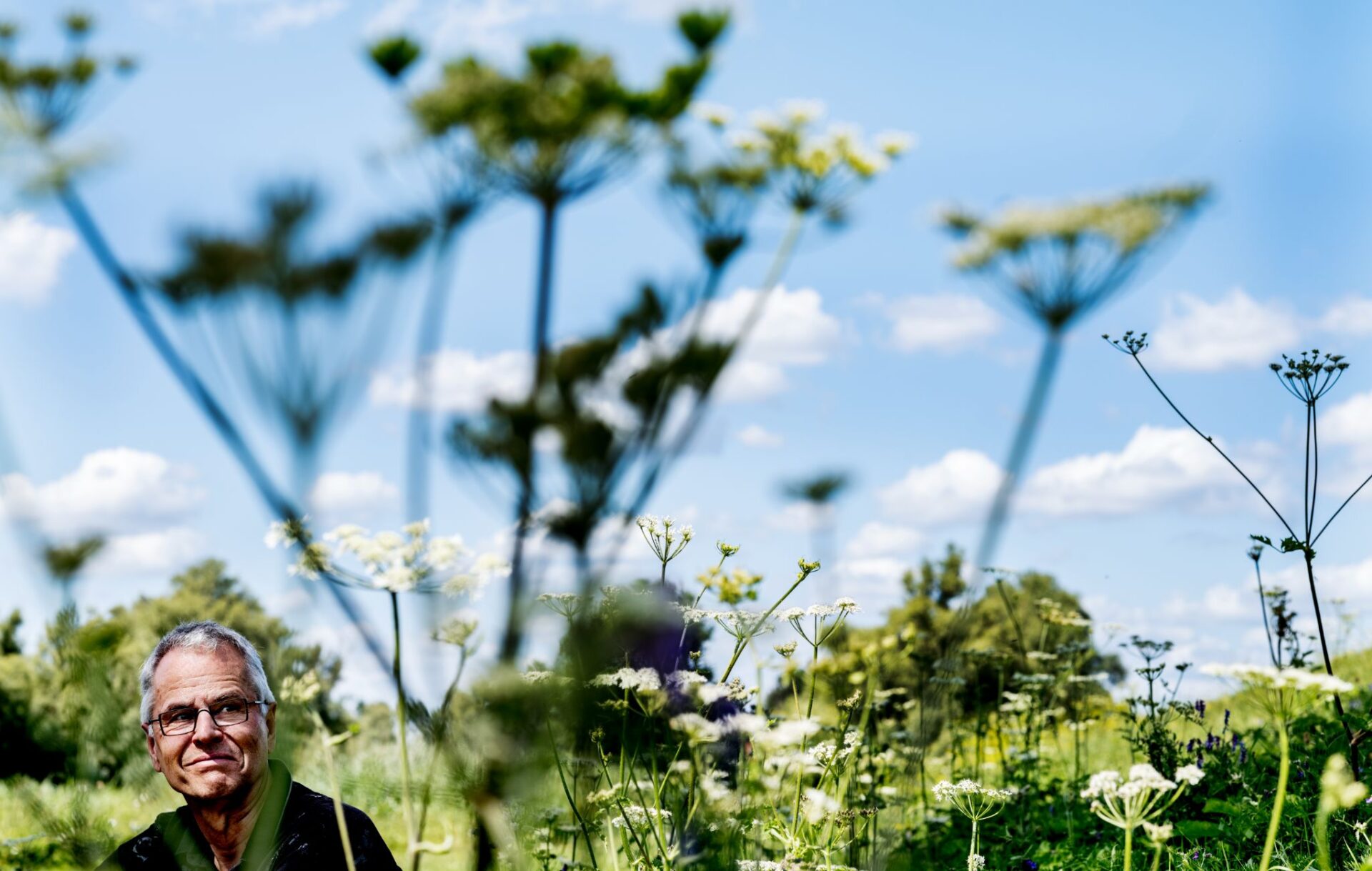
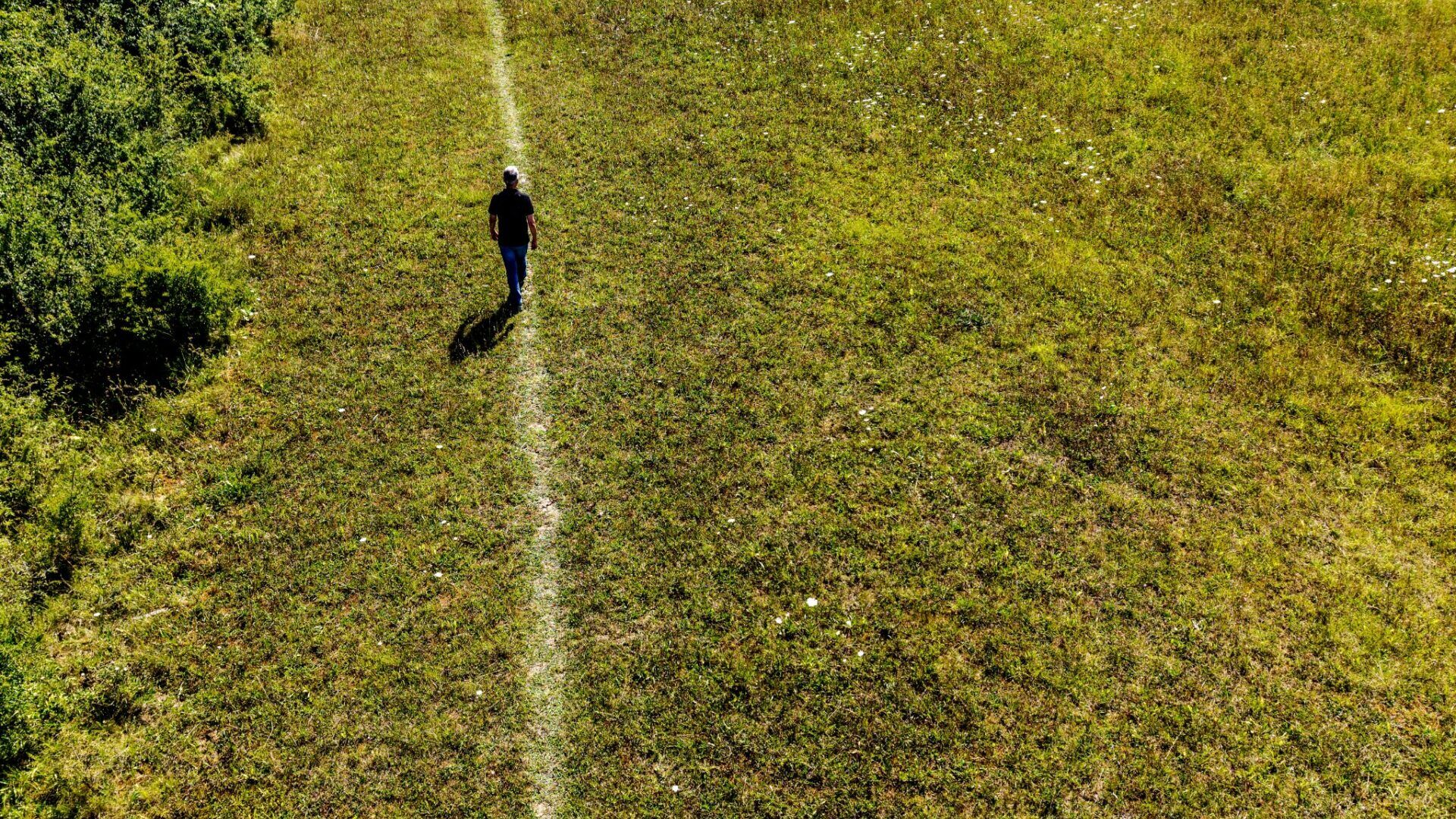 De Ooijpolder bij Nijmegen, met Hans de Kroon. Foto: Duncan de Fey
Three-quarters of all flying insects turned out to have vanished over the course of 27 years. That conclusion, published in 2017, became Hans de Kroon's most striking contribution to science. Yet the professor of Experimental Plant Ecology — who steps down from Radboud University in September — refuses to let bad news about the natural world get him down. 'That's just not how I'm wired. I want to show that things can be done differently. In the Ooijpolder you can see nature flourishing, against the odds.'
When he began studying biology as an eighteen-year-old, Hans de Kroon could never have imagined how topical his field would one day become. The word biodiversity had yet to be coined; apart from a handful of ecologists, hardly anyone gave nature a second thought. It was an era in which, after a long car journey, you still had to wash the squashed flies off your windscreen with a sponge.
The discovery that the number of flying insects had fallen by three-quarters thirty years later would become, in 2017, his most sensational contribution to science. ‘That image of the little creatures no longer stuck to the windscreen struck a chord immediately,’ he says during a walk through the Ooijpolder. ‘It got under people’s skin. Everyone sensed that something wasn’t right.’
Biography
Name: Hans de Kroon
Born in: Oudenbosch (1959)
Education: Biology (Utrecht University)
Worked at: Radboud Institute for Biological and Environmental Sciences (RIBES)
Recent Projects: Living Labs for Biodiversity Restoration in Rural Areas (NWO-NWA), Future Dikes (HWBP–STOWA), Transition to a Sustainable Food System (NWO-NWA)
Other Positions: Chair of the Netherlands Ecological Research Network (NERN); Member of the Supervisory Board of Het Utrechts Landschap; Member of the Supervisory Board of Stichting Bargerveen; Member of Academia Europaea and the Royal Holland Society of Sciences and Humanities (KHMW).
The Ooijpolder as a laboratory
A pair of binoculars hangs around his neck. He always brings them along on a ramble. De Kroon loves watching birds — the marsh harrier, the sparrowhawk with its handsomely streaked breast. He also enjoys photography, preferably of fragile little plants gamely holding their own in their surroundings. With a macro lens.
‘I’m not the kind of person who knows the names of every plant,’ he says, a touch apologetically. ‘That’s got nothing to do with age, mind you — I’ve never had a memory for it.’
He is 67, and since the start of the summer his state pension has been paid into his bank account each month. The emeritus professor won’t be seeing much of the inside of lecture halls from now on — which leaves all the more time to get outdoors.
‘I’m not the kind of person who knows the names of every plant’
The Ooijpolder is the largest laboratory he has ever had at his disposal. ‘Living labs‘ is what he calls his life’s work: here among the meadows, the ice-pushed ridge and the river, he worked with countless partners to boost biodiversity. And with success.
You call the little field we’re standing beside a ‘partridge patch’. I see tall grass and yellow flowers. Was that sown specially for the partridge?
‘Yes. The grey partridge is a farmland species that’s doing badly and just won’t recover. It needs spots like this to breed and to hide. There’s plenty of food here, and it works very well. The farmer who owns this land isn’t allowed to simply mow it whenever he likes.’
And you count how many partridges there are and by how much that number is rising?
‘Volunteers do that — I don’t do it myself.’
At the table with the farmer
For about ten years now, a large part of the polder next to Nijmegen has been De Kroon’s research area. Alongside the partridge patch, small pools have been dug that attract creatures such as newts. Strips of flowering herbs alternate with old-fashioned maize fields and potato plots — the flowers draw in new insects. The Nijmegen ecologist was the driving force behind a research project to map the Ooijpolder’s success and learn from it.
How do you get farmers to work with scientists? They have to lend out valuable farmland to do so.
‘With patience. These aren’t processes you sort out in five minutes. You have to pull up a chair at the farmers’ kitchen tables. Explain what you have in mind, show an interest in their business, ask what they think of the landscape and what they’re proud of. Tiny Wigman of the ViaNatura foundation played a big part in this; she guides these kinds of change processes in the countryside. You also have to make sure the financial side adds up. A farmer who makes his land available for a partridge patch receives a payment for it from the government. He doesn’t make a profit, but he shouldn’t make a make a loss as well.’
Does it help win their trust that you grew up on a farm yourself?
‘I think it does. It helps if you know how a farm works and what language is spoken there.’
The pesticide link
As tiny frogs dart away through the grass at our feet, De Kroon talks about his childhood in West Brabant. His father ran the farm belonging to a large religious community in Oudenbosch. It was a mixed operation, with around 25 cows. Young Hans enjoyed driving the tractor and picked strawberries as a part-time job, but he wasn’t especially interested in farming life. Because he was good at the sciences yet didn’t quite know what he wanted to become, he decided to study biology in Utrecht.
‘It was only when we went out into the field with a lecturer that I saw all the plants growing there. I’d never had an eye for them. We studied the soil, too, full of all sorts of creatures. That’s how I gradually drifted into this field. It wasn’t planned in advance.’
De Kroon loved both the statistical work and experimenting with plants. His lecturers advised him to take one of those two paths and not to combine them. Better to become good at one thing, they felt. De Kroon was headstrong and specialised in both. ‘To this day I believe you need both for solid research.’
‘It was only when we went out into the field with a lecturer that I saw all the plants growing there. I’d never had an eye for them’
The ultimate proof was the insect study that caused such a stir almost ten years ago. Data, models and calculations were crucial to it. Back in 2014, De Kroon and his Nijmegen PhD student Caspar Hallmann had already published an article in the science journal Nature linking the decline of insect-eating songbirds — such as the skylark, the barn swallow and the yellow wagtail — to pesticides. To do so, they had combined data from bird research organisation SOVON with figures from the water boards on the pollution of surface water.
‘We already assumed there had to be fewer insects available as food for those birds, but we couldn’t prove it. Until suddenly the Germans turned up on our doorstep.’
‘The Germans’ were a group of entomologists from Krefeld who got in touch after the Nature publication. With characteristic Deutsche Gründlichkeit, our neighbours had spent 27 years measuring insect numbers in 63 different nature reserves. They caught the creatures in traps and documented every reading. They were more than worried about the visible decline — something they had sounded the alarm about themselves, to no effect — and now they wanted to team up with the Nijmegen researchers.
‘Working from their data, we carried out a scientific analysis. The result was truly alarming: more than 75 per cent of flying insects turned out to have disappeared over 27 years.’
The university put out a press release about the findings, and before long Maarten Keulemans, science journalist at De Volkskrant, was on the line. ‘He was completely upset,’ says De Kroon.
He would not be the last. The media pounced on the news. The next day the Nijmegen ecologists were on the front page of NRC and appeared on the talk show De Wereld Draait Door. ‘Caspar Hallmann and I divided up the tasks. You do CNN? Then I’ll take the BBC. It was a completely mad situation.’
Were the pesticides the culprits?
‘They were certainly among the suspects — very much so — but we’re ten years on now and we know there isn’t a single cause. What does stand out, in any case, is that the nature reserves we mapped in Germany, and later in the Netherlands too, are all surrounded by farmland. So we’re quite sure that nitrogen and pesticides play a part. But it’s a combination of factors. Habitat loss has an influence as well. Here in the Ooijpolder we can see that when you make room for nature again, insect numbers bounce straight back.
The decline of wild flowering plants and the fall in insect numbers are also connected; the two go hand in hand. But we can’t say exactly which is the cause of what.’
How do you explain the enormous shockwave the news sent out?
‘This report touched people’s feelings. They also recognised what we were writing. As in: “this is right, because I’ve seen it myself too.” No more flies on the windscreen… Something really was going on, and we all sensed that such a huge drop in insect numbers wasn’t in our favour and that something had to be done.’
What happened?
‘Our unique selling point as scientists was, of course, that we brought conclusions no one could ignore any more. Discussions started at policy level, and shortly after our insect study appeared, four important neonicotinoids — the agricultural pesticides we’d published about in 2014 in relation to the meadow birds — were banned in Europe. So yes, we’d achieved something by then.’
Another gain: support grew. The Delta Plan for Biodiversity Recovery, now with 90 partners, was set up — the source of projects such as the living labs in the Ooijpolder. The willingness of municipalities, nature organisations, water boards and farmers to take part increased.
Strengthening the dikes
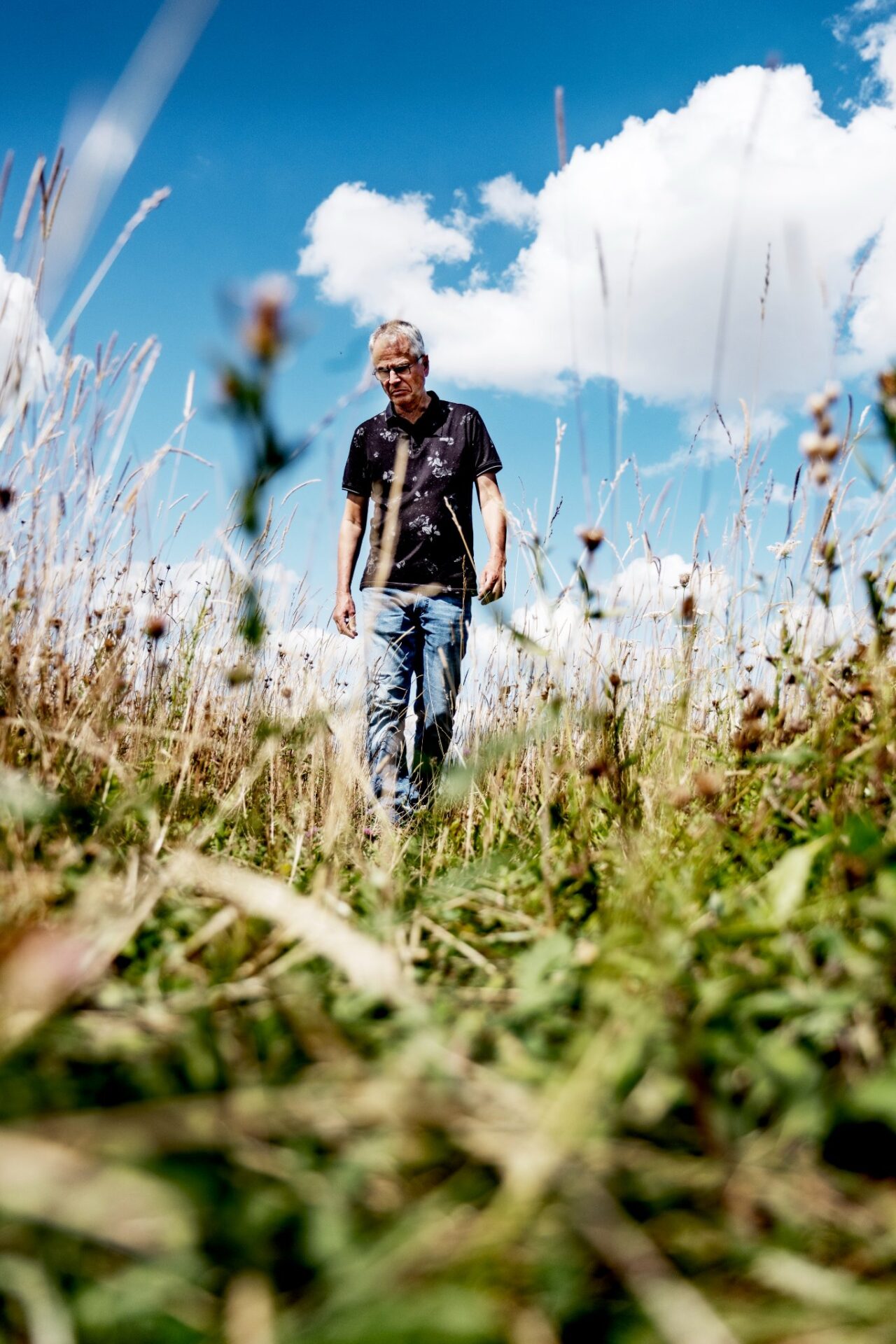
Under the blazing sun we walk along a farm track. In recent years, various routes have been laid out across the area De Kroon knows like the back of his hand, so that walkers can see what is happening here. A landscape broken up by hedgerows and flowers appeals more than an unbroken string of meadows. Here and there stand small signs — as at the partridge patch — explaining to the public what is being done to increase biodiversity.
Hans de Kroon points at the ground. It is dry. But that’s not what he’s getting at. He wants to explain how the roots of plants behave. That, too, was something he researched extensively during his years at Radboud University.
‘The bit we’re standing on now was laid out not long ago. It’s a flower strip. We study how all these different species get along with one another. You’d think they’d crowd each other out with their roots and that the strongest would win out. But that’s not what happens. Look at grasslands where dozens of species have stood together for hundreds of years, without one species knocking out the other.’
‘You’d think the plants crowd each other out with their roots and that the strongest would win out’
To follow the behaviour of roots more closely, he built a root lab on the Nijmegen campus. It’s a tunnel greenhouse where biologists run experiments with different species. ‘What we saw was that one plant doesn’t push out the other; instead both produce more roots. They don’t go deeper — they interweave their roots in the top layer of soil. That layer becomes much stronger as a result.’
That was a game changer. And a stepping stone to the idea that dikes covered in flowers, which are lovely to look at, are at least as strong as dikes with nothing but grass. The Nijmegen biologists got in touch with the water boards to share their insights. Behind the Huygens building on the Nijmegen campus they built a facility where they experiment with different seed mixes to arrive at the strongest possible root layer.
‘On the Meuse near Balgoij we poured an enormous wave of water over a stretch of flower-rich dike to test its strength. And the dike held. In the end the director of the Flood Protection Programme said: “You know what? Let this be the new standard.” I’ve had that remark — figuratively speaking — framed and hung above my desk.’
The Netherlands has some 17,000 kilometres of dikes, so there’s plenty to do. Biodiversity will be the biggest beneficiary of the Future Dikes project, as it is officially called. De Kroon: ‘But it also simply looks beautiful.’
More than doom and gloom
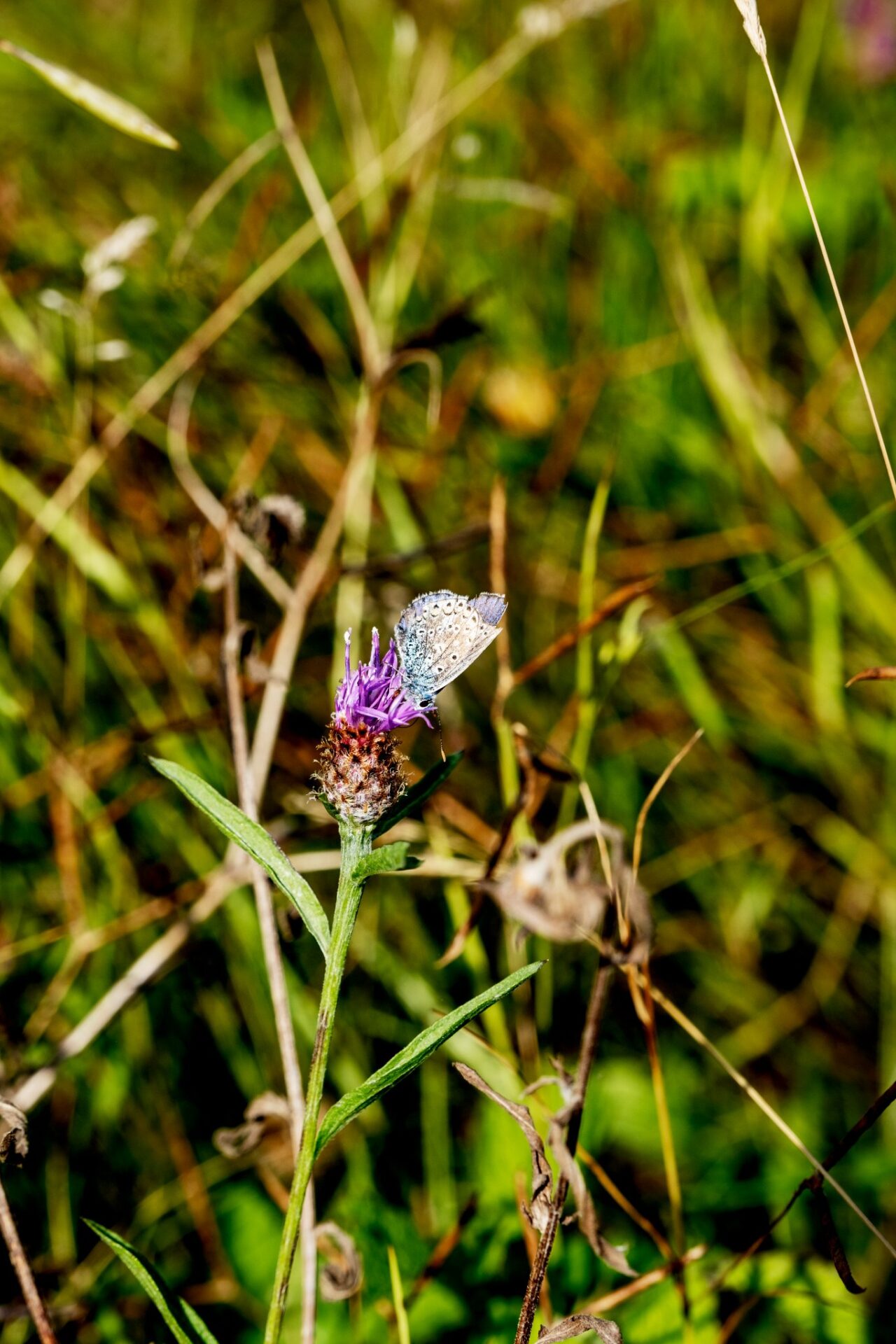
The hard ground we’re now standing on lies a good deal lower than the surrounding meadows. Thirty centimetres of topsoil has been scraped away here, the professor explains. It was heavily fertilised farmland, and into the nutrient-poor layer that was left, cuttings from existing flower-rich meadows were introduced. Even though it’s bone dry and high summer, flowers are still blooming here — among them the purple-blue common knapweed and white wild carrot.
‘Beautiful, isn’t it? I often bring people here. I’ve shown Icelandic and Australian film crews around to show them how it can be done. I don’t want to tell only stories of doom and destruction and decline and misery.’
Valedictory lecture
Hans de Kroon will deliver his valedictory lecture on Friday 11 September 2026 at 3.00 p.m. Venue: the Aula, Radboud University. Those wishing to attend must register via the website.
Why not?
‘Because it doesn’t work. It doesn’t get people moving. Here you can see nature flourishing, against the odds.’
At the same time, species are disappearing. Does that never make you gloomy?
‘No, that’s just not how I’m wired. It will never be the way it once was, but we can already catch a glimpse of the biodiversity that’s on its way. Scientists could stand to focus a bit more on the future. The tricky part is that this is also dangerous. If you say, “look, nature is doing well again here,” you know full well there are nitrogen deniers waiting to respond with “see, there’s no problem at all.”‘
Like much of the country, he’s going on holiday this summer. But not in a Boeing. Flying clashes with his principles; he simply finds it too polluting. For a few years now, De Kroon has avoided conferences that can’t be reached by train or car. ‘My wife and I are going away in a camper van next week,’ he says. ‘We fill it up with the cleanest diesel we can. There are plenty of beautiful places in Europe too. Just as there are in our own country.’
Our other Summer Interviews:
1. Spinoza Prize winner Karin Roelofs: How a tiny mouse sparked a major study on stress
2. Communication scientist Rebecca de Leeuw on resilience and her son, who was born deaf
3. Jan Mustafa fled Syria — in Nijmegen, his main goal is helping others
4. Wheelchair basketball star Bo Kramer (27): ‘As an elite athlete, you have to love pushing yourself to the limit’
5. Sander Leeuwenburgh, the dentistry professor turning full-time pianist
7. Professor Paul van der Velde: ‘People often think I’m a Buddhist’