Summer interview (7) with professor Paul van der Velde: ‘People often think I’m a Buddhist’
-
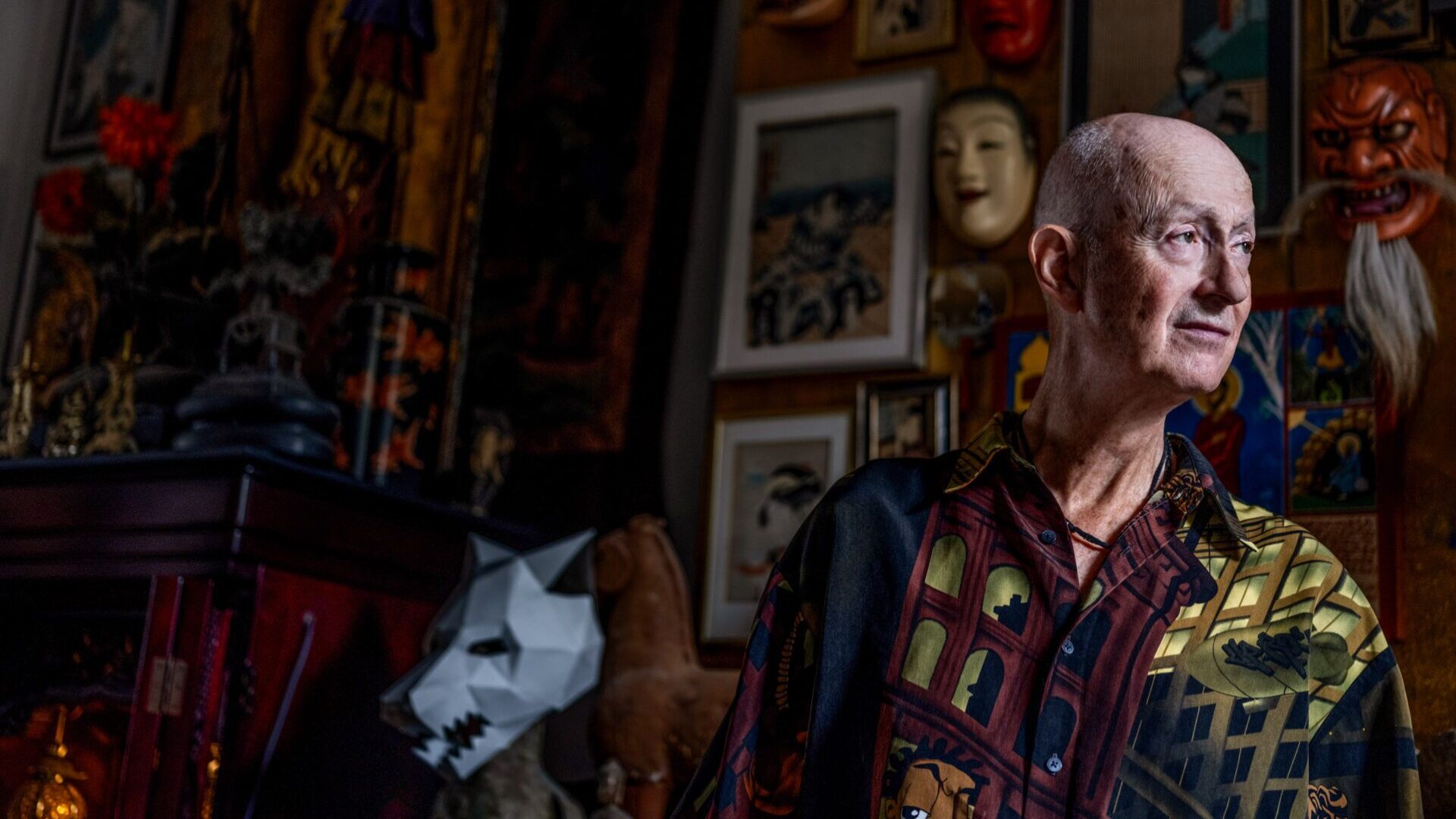 Paul van der Velde. Foto: Duncan de Fey
When he started out as a student, India was all the rage among young people longing for an earthly paradise. As a professor of Buddhism and Hinduism, he watched Buddhas pop up in garden centres. For Paul van der Velde, Asian religions became his life — and that won't change now that he is retiring. 'The first time I was in India, I felt it immediately: this is it.'
Monday is yellow, Tuesday is beige and black. Today — Wednesday, the day we meet — is green. For professor Paul van der Velde (67), every day of the week has a colour. And every colour sounds different. To him, the glass of yellow cordial on the table gives off a droning hum. He imitates it: “Zzzzzz.”
Van der Velde has synaesthesia, a condition in which his senses work together in an unusual way. When he listens to Vivaldi or Bach, he sees beautiful colours, shapes and lines. They run through his field of vision like a kind of subtitling.
Biography
Name: Paul van der Velde
Born: Someren, 1959
Education: Indian Languages and Cultures (Utrecht and Leiden Universities)
Worked at: Faculty of Philosophy, Theology and Religious Studies (FTR), Radboud University; Utrecht University; University of Groningen
Recent publications: Weg van het Onbekende: de zin van het Niet-Weten (The Path of the Unknown: The Meaning of Not-Knowing, 2022), with Ignace de Haes; Jizo, portret van een beminnelijke god (Jizo: Portrait of an Endearing God, 2024), with Richard Grol; Onvergeten Fragmenten (Unforgotten Fragments, 2024); Elementair deeltje Boeddhisme (Buddhism, in the Elementaire Deeltjes series, 2024); Een Turkooizen bij, liederen van de zesde Dalai lama (A Turquoise Bee: Songs of the Sixth Dalai Lama, 2024); Donker gestold zonlicht. Het oude pad van de voorouders (Dark Congealed Sunlight: The Ancient Path of the Ancestors, 2026)
Also: adviser on Asian art, painting and traditional recitations; tour guide
It was only a few years ago, when he heard the physicist Robbert Dijkgraaf talk about his own synaesthesia on television, that he thought: I have that too. Until then he had assumed it was normal. But it turned out to be a neurological phenomenon that occurs in an estimated 2 to 4 per cent of the population.
When you look at art, does it come across differently for you than it does for me?
“Possibly, yes. Colours can clash — that sounds like a dissonance to me. My partner and I sometimes advise people on their clothing. I know an outfit works when I hear a harmony in the sounds the colours make together. And for me, tastes can have colours too.”
Isn’t that distracting?
“Not in the least. In fact, I find it very pleasant. But then I’ve never known anything else. There are people whose colours run right across their field of vision — I can imagine that being a nuisance for them.”
No successor
For Van der Velde, discovering the term synaesthesia was an eye-opener. Suddenly he looked differently at a phenomenon like being able to see auras. He doesn’t rule out the possibility that there are people who can genuinely perceive body heat in different shades.
“Why not?” He knows someone, he says, who also has synaesthesia and can tell an Achterhoek accent from a Twente one by looking at the colour of the sounds. His point is simply that we all see the world differently. “People who are merely colour-blind already have a different perception of the things around us.”
‘I have what they call in Asia a cool heart’
For thirty years he was the first and only professor of Buddhism and Hinduism at Radboud University. And, for the time being, the last, because there is no successor. He finds that a shame, because in his view students of religious studies should also be taught about Asian religions. On top of that, the teaching he did in four languages now falls away as well. At the same time, he isn’t the type to get too worked up about it.
“I have what they call in Asia a cool heart,” he says, as his partner, Godfried Beumers, serves a slice of Limburg vlaai (a regional fruit tart). “In our language that sounds negative, but it means you’re not easily thrown off balance. I prefer to call it a calm heart myself.”
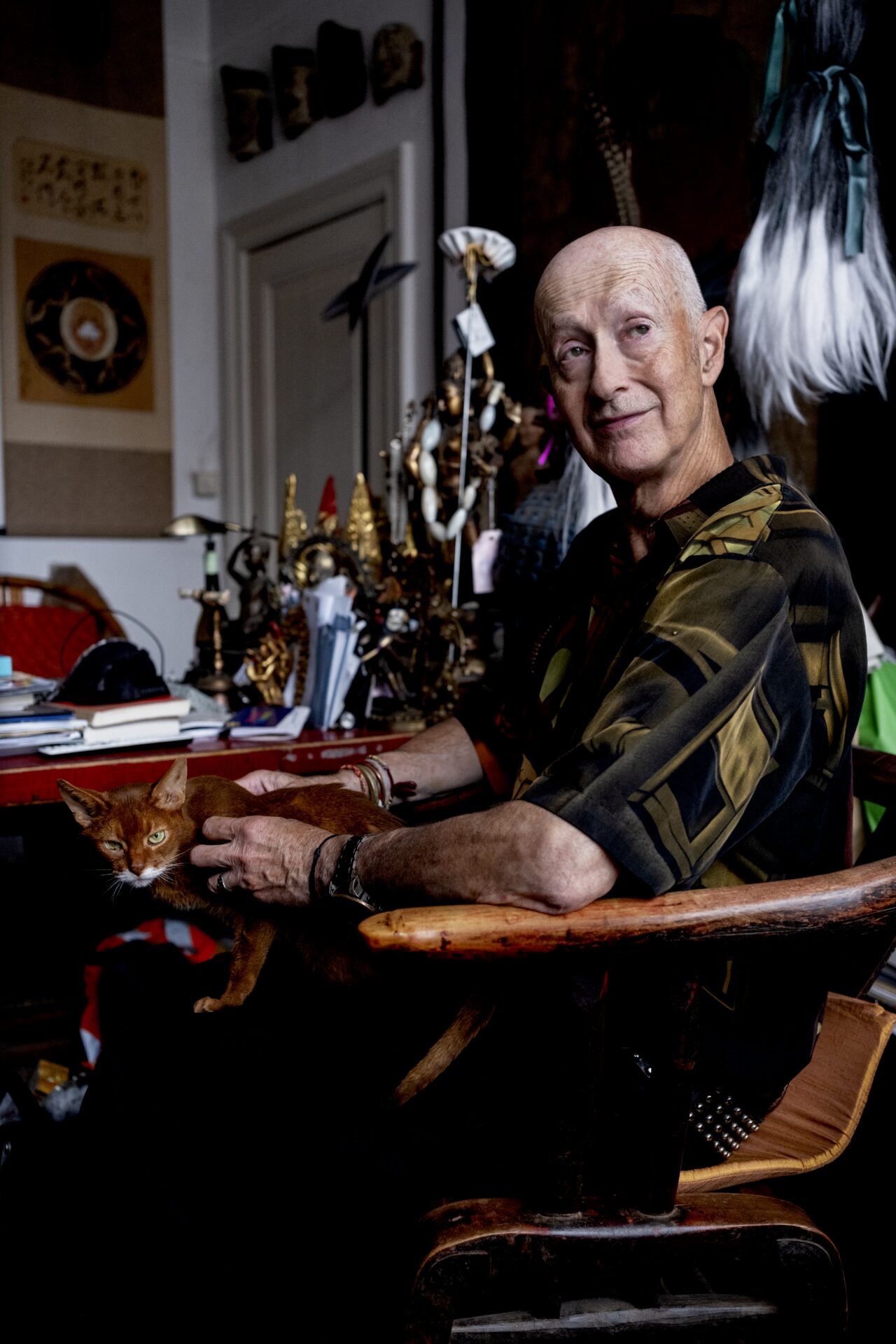
His living room is full of colourful statues that, in his synaesthetic mind, must sound like an exuberant brass band. That doesn’t trouble him either, he says. A desk so red it seems to be ablaze stands in the middle of the room, and it’s precisely there that he likes to sit and write in peace.
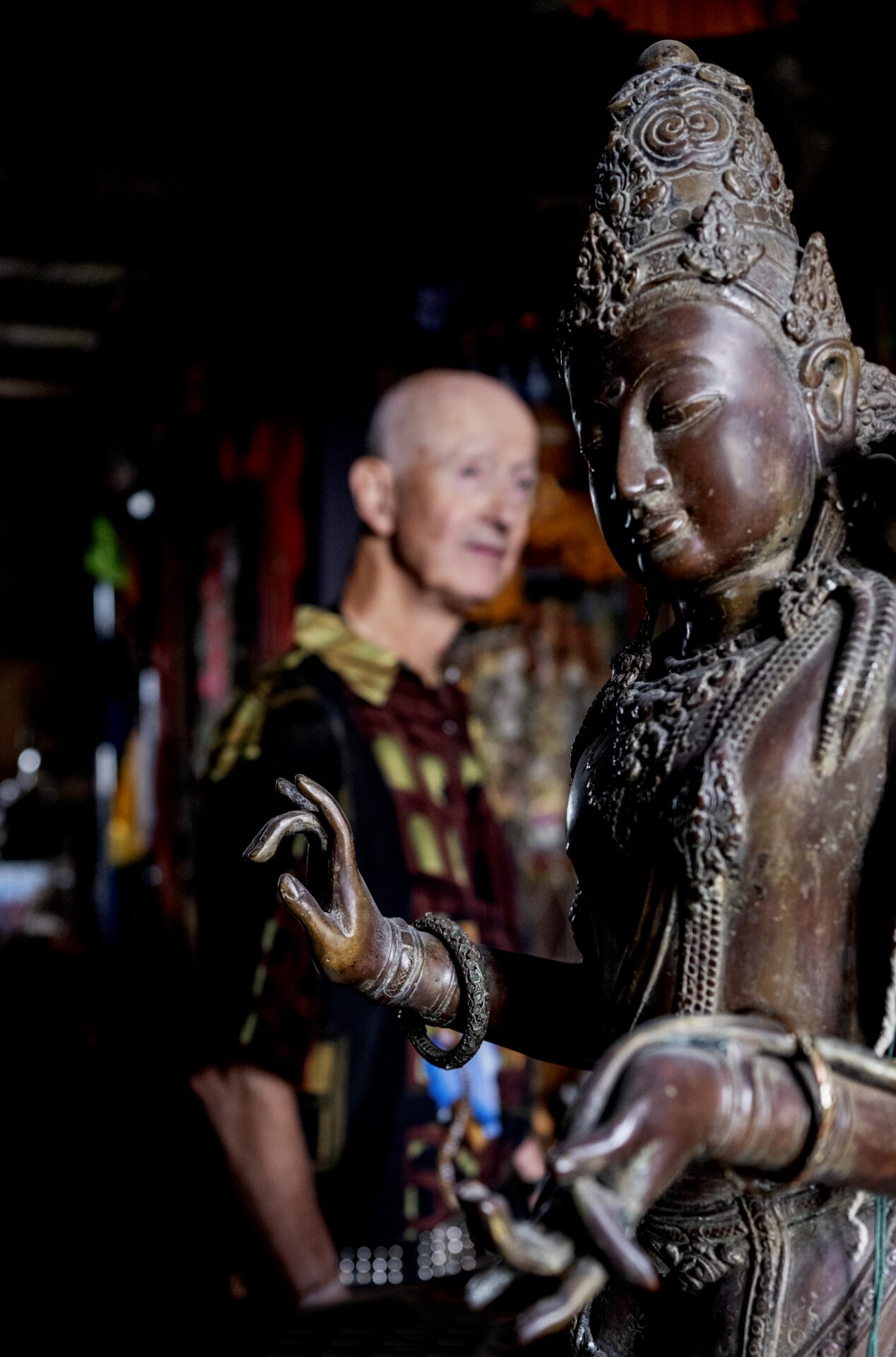
On the seventeenth floor of the Erasmus building, his office was a spectacle for years. Hundreds of statues were crammed into a space just a few square metres in size. A pair of Asian gods stood guard in the corridor. Part of the collection Van der Velde assembled himself has this week been added to his collection at home. Another part is going to Museumpark Oriëntalis, so that other people can enjoy it too. And, well — because his house is only so big.
“All the statues are equally dear to me,” he says. “They each have their own story too.”
Before becoming a professor, he supplied art dealers and auction houses with descriptions of the statues they acquired. As an expert on Asia, he knew what he was talking about — and he was a lover of the work. That’s how he came by, among other things, the man-sized eighteenth-century Burmese Buddha that now stands in his living room. “Once I had enough money, I was able to buy it myself.”
The aesthetics of India
In the course of his life, Paul van der Velde travelled to Asia more than ninety times. The first time, he was nineteen. The trip was a culture shock for the student, who was used to little more than the small Brabant village of Someren where he grew up. “But I felt it straight away: this is it.”
The aesthetics of India had enchanted him even earlier, as a small boy, when he saw a picture in a history book of the dancing Shiva that would later end up in the Rijksmuseum. It was the dynamism and the stillness united in a single figure. The image kept surfacing in his thoughts and never stopped inspiring him.
After a year at art school — “I missed the intellectual depth” — he began studying Indian Languages in Utrecht. “I was one of 21 students who wanted to learn Sanskrit that year. This was in 1987, in the aftermath of the seventies and the Bhagwan hype. In the end, only about three of those 21 students were left.”
The rest were only looking for spirituality and an earthly paradise rather than for scholarship, and gave up quickly. Van der Velde dived deep into the ancient languages and later, as a doctoral candidate in religious studies, into the history of India. He specialised in Hinduism and Buddhism. Alongside that, he earned money as a tour guide — something he still does to this day.
“I’ve just got back from eighteen days in Mongolia; a woman broke her hip in the South Gobi. In the end she had to be lifted out of the desert by helicopter.”
‘The Buddhas took the place of the garden gnomes at the edge of the pond’
Van der Velde tells the story with his self-styled calm heart. Yes, it was a great deal of arranging, and the woman was 85. But her perseverance was impressive, and in the end everything turned out fine. He looks cheerful as he says it. “In early September I’m off to Nepal with a group; in October to eastern India.”
Interest in Zen Buddhism took off in the West during the years you were a professor. At Blokker and Intratuin [Dutch household and garden-centre chains] you could even buy Buddhas. What did you make of that development?
“The Buddhas took the place of the garden gnomes at the edge of the pond. That’s how it went, yes. I even wrote a book about it: The Buddha in the Garden Centre. Godfried’s neighbour had one in her front garden too, and I once asked her why. She said it made her feel calm. Well, fair enough, isn’t it? I have no problem with that.
Neither do the Buddhist monks in India, for that matter — I’ve never once heard one of them complain about it. It’s usually the professed Buddhists in the West themselves who have trouble with it.”
With the cherry-picking?
“Yes, because they feel Buddhism is being secularised and that people are just picking out whatever they can use. It went the same way with meditation. That technique blew over from Asia in the sixties and seventies.
In Buddhism, the ultimate aim of meditation isn’t to make you calm. Buddhists train their minds because they want to reach a state of enlightenment, often with the goal of developing wisdom and feeling compassion for all living beings.
De-stressing is a side effect, and that side effect became dominant here. Mindfulness went all around the world. The nice thing is that a great deal of research has been done into it in the West — for instance by applying it in psychotherapy and medical treatment. Those scientific insights then travelled back to Asia.
In Asia people have the same problems with stress as we do. And now you see the thinking there too: meditation may not be the goal in itself, but if it improves quality of life…”
120 dowry murders
The only professor of Buddhism and Hinduism in Nijmegen rode the wave of India’s popularity. He was a much-sought-after speaker, writer and course leader. At the same time, he never wanted to contribute to the romantic image of a country where people aren’t materialistic and spend the whole day meditating. Because it simply isn’t true, he says.
“In 1988 I stayed in Delhi for a longer period. The paper reported that in that city alone, that year — and it was only October — there had been 120 registered dowry murders. That has always stayed with me. It concerns the husband’s family killing the new bride because her family hasn’t brought enough money. A girl like that is set on fire in her kitchen, say, so the groom’s family can quickly go looking for a new daughter-in-law.”
Grim — but fortunately the number of dowry murders has since fallen. If a girl in India now dies within five or six years of marriage, Van der Velde says, it is investigated from every angle. “But then again, you can bribe the police too…”
When he comes across zealots who claim that Buddhism knows no dogmas and that no war has ever come out of the religion, the teacher in him rises to the occasion. He points to the history of Tibet, where Buddhist monasteries even waged wars among themselves. In the seventeenth century the fifth Dalai Lama fought against Bhutan, and Tibetans also raided and killed travellers along the Silk Road.
‘Buddhists non-violent? That’s wishful thinking from Western esotericism’
Or take Japan, where various monasteries had their own armies and took up arms against one another. The idea that Buddhists are non-violent he calls “wishful thinking from Western esotericism.” Zen monks blessed the kamikaze pilots in the Second World War, violence against women and rape are a deeply rooted problem in India, and women there are by no means equal to men.
“There are of course a great many kind Buddhists, but the hatred against the Rohingya in Myanmar really is led by a monk, Ashin Wirathu.”
Indian dance
That there are also negative sides to India, Hinduism and Buddhism has been reported extensively by the media over the past decades. That could well be why the country has become a good deal less popular among backpackers craving spirituality, Van der Velde suspects. A touch cynically: “They go to South America now, because there they can drink ayahuasca.”
You’re not a Buddhist yourself?
“No, though people often think I am. I have adopted things from Buddhism and Hinduism. When I enter a room, I’ll always put my right foot over the threshold first. That’s a Brahmin tradition I learned from a Hindu family I stayed with for a long time. I’ll also never stand on a threshold if I don’t have to. It has to do with the transfer of good and bad fortune. I also did Indian dance for years. I can still do all the hand gestures.”
‘When I enter a room, I’ll always put my right foot over the threshold first’
He clasps his hands together and moves his fingers above the tabletop: the gesture for a parakeet flying away. Then a new finger choreography meant to represent the flute-playing Krishna. After that the god Shiva seated on a bull. Murugan on a peacock. Ganesha on a mouse. His fascination with Asian religions and stories was always more than scholarship alone. Through dance, he gave it physical form. But he also paints, and likes to wear clothes made for him by his regular tailor in Nepal.
Are you then still able to look at those religions as an objective scholar?
“Some colleagues will feel that embodiment came at the expense of scholarly detachment. It makes me think of Ron Grimes, a former professor of Ritual Studies in Nijmegen. He was a very inspiring man, an old hippie with a big beard. He spoke about the concept of stepping in and stepping out.
First you become an observer, then a participant, and then a believer. All of that is fine, as long as you also know how to take the steps back — and, from believer, end up behind your desk again in the end. There you can analyse and write down what you’ve seen. I find that something essential.”
A Catholic boy
Paul van der Velde never felt the need to convert to another religion, although in Asia he was initiated into various traditions. He grew up a Catholic boy. He made his first communion and confirmation, but never really believed in the Church. Even so, he regards his ecclesiastical roots as an asset — because he knows what it is to live within a religious system. That makes it easier for him to empathise with people who grow up in similar networks.
One day, once he was already an adult, he tried to deregister from the Catholic Church, on account of the abuses within the institution. For some reason it didn’t work, and in hindsight that failure was a blessing for his career.
“When I was appointed professor at the Catholic University of Nijmegen (the former name of Radboud University, ed.), Cardinal Simonis had to give his approval. He phoned the professor of Philosophy of Religion to ask whether I was a professing Catholic. And whether I went to church regularly. As it happened, I’d just been to the Grote Kerk in The Hague that very weekend for an antiques fair, so that professor could say I visited a church fairly regularly for significant and old things. Antiques count as old things too, don’t they?
Simonis also phoned the parish priest in my village, Someren. That man said: ‘The Van der Velde family is a respectable Catholic household.’ I got the job in Nijmegen.”
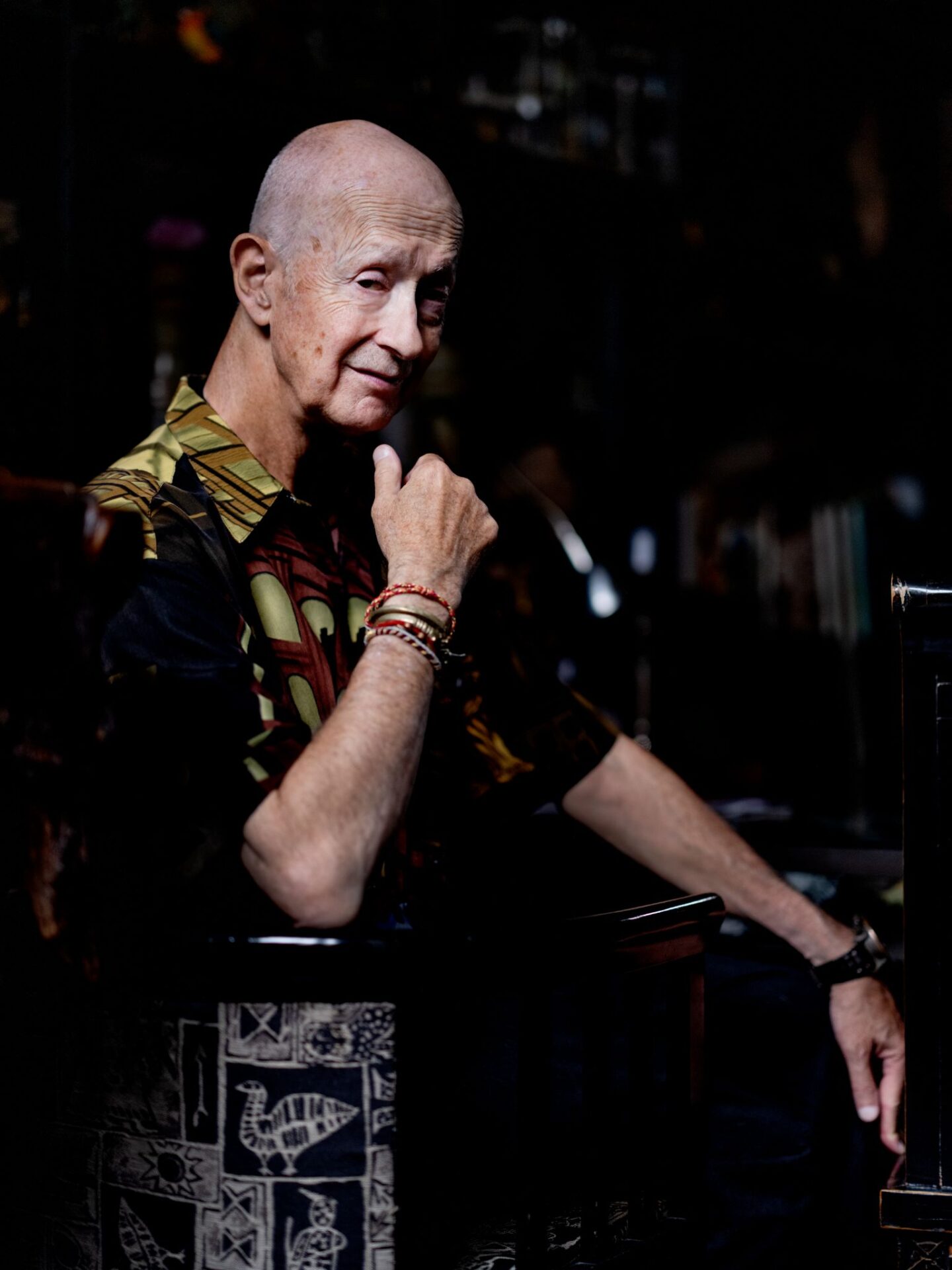
The theatre-maker Godfried Beumers tops up the cordial glasses again. He has been Van der Velde’s partner for almost thirty years. One thing Catholicism, Buddhism and Hinduism have in common is that none of them welcomes homosexuality. When the professor and his partner are in Asia together, they say they live in the same house as best friends. Stating explicitly that they are in a relationship isn’t possible, Van der Velde says. “Even though anyone paying attention knows perfectly well how things stand.”
A hundred thousand verses
In Asia he adapts. In Nijmegen he doesn’t; there he has always felt free to be who he is. Even at a Catholic university. “The fact that I was openly gay and living with Godfried even became something of a calling card, I felt. It had an emancipating effect. Students who were struggling with their identity would sometimes come to me.”
‘The one who will eventually drop out of this collection is me’
He was in the right place in Nijmegen, he says. In all those years he never applied for another job. Even the Erasmus building — which colleagues so often complain about — he found a very pleasant place. The move of Religious Studies coincides with his farewell. But in the new premises, the Maria Montessori building, he’ll still get a small desk of his own as an emeritus. “I still have a lot of theses to finish off, and the doctoral projects run on for a while yet. This coming spring I’ll also give one more course.”
After that he’ll throw himself into translating great epic works from Sanskrit, among them the Mahabharata, which runs to a hundred thousand verses. At home, at his fire-engine-red desk, among all the statues he collected in his lifetime.
Smiling: “The one who will eventually drop out of this collection is me.”
Paul van der Velde’s valedictory lecture is on 27 November. Keep an eye on the agenda for further details.
Our other Summer Interviews:
1. Spinoza Prize winner Karin Roelofs: How a tiny mouse sparked a major study on stress
2. Communication scientist Rebecca de Leeuw on resilience and her son, who was born deaf
3. Jan Mustafa fled Syria — in Nijmegen, his main goal is helping others
4. Wheelchair basketball star Bo Kramer (27): ‘As an elite athlete, you have to love pushing yourself to the limit’
5. Sander Leeuwenburgh, the dentistry professor turning full-time pianist
6. Hans de Kroon, the ecologist who explained why you no longer need to clean bugs off your windshield (because there are hardly any left)