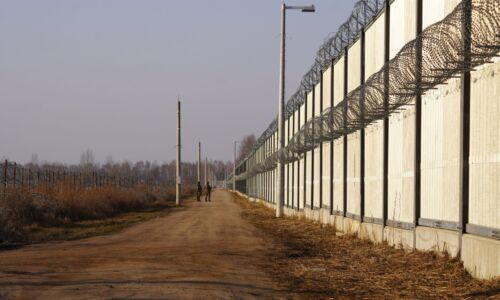
Khan and Abdullah survived fifteen days in the ‘death zone’ between Poland and Belarus
-
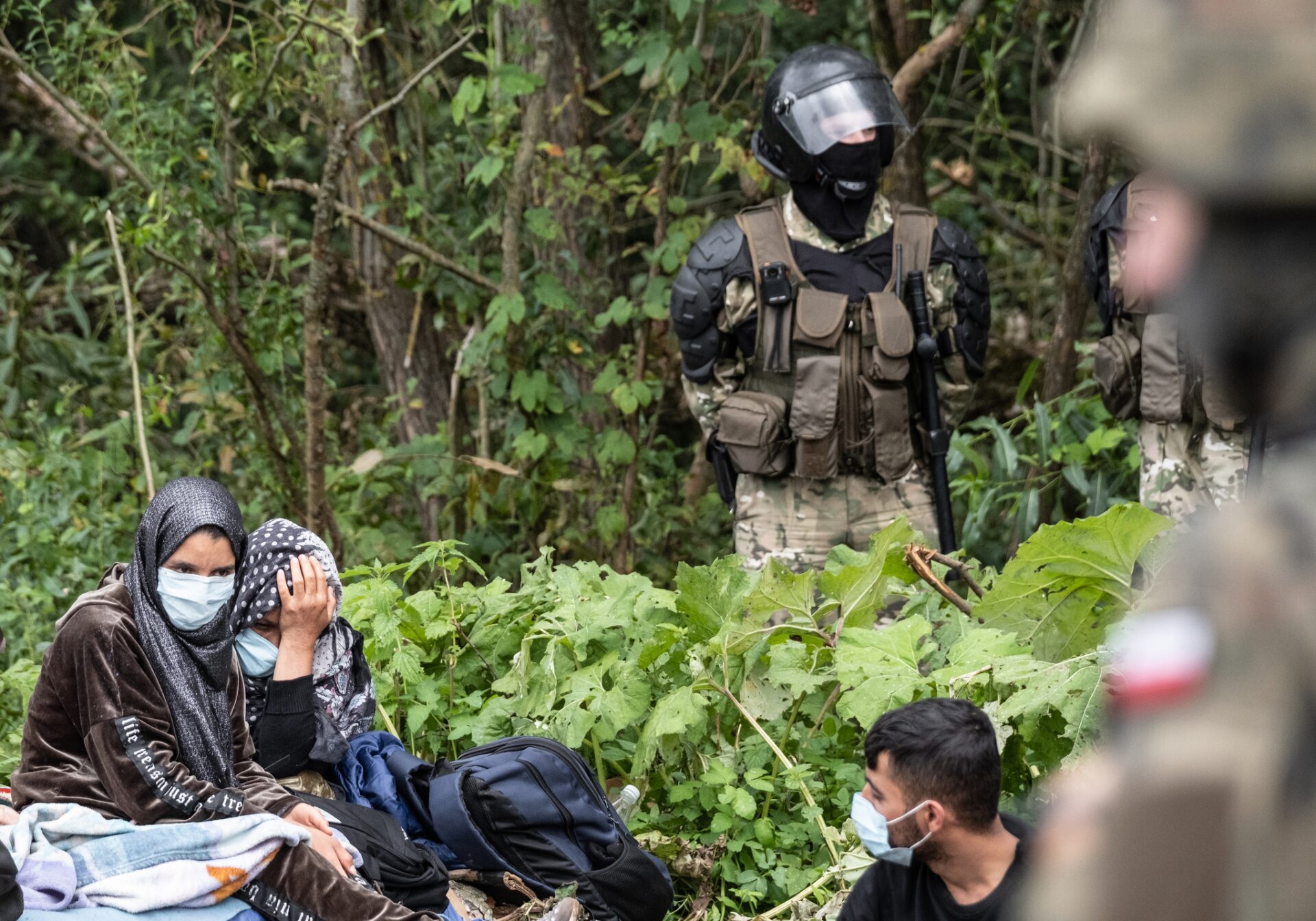
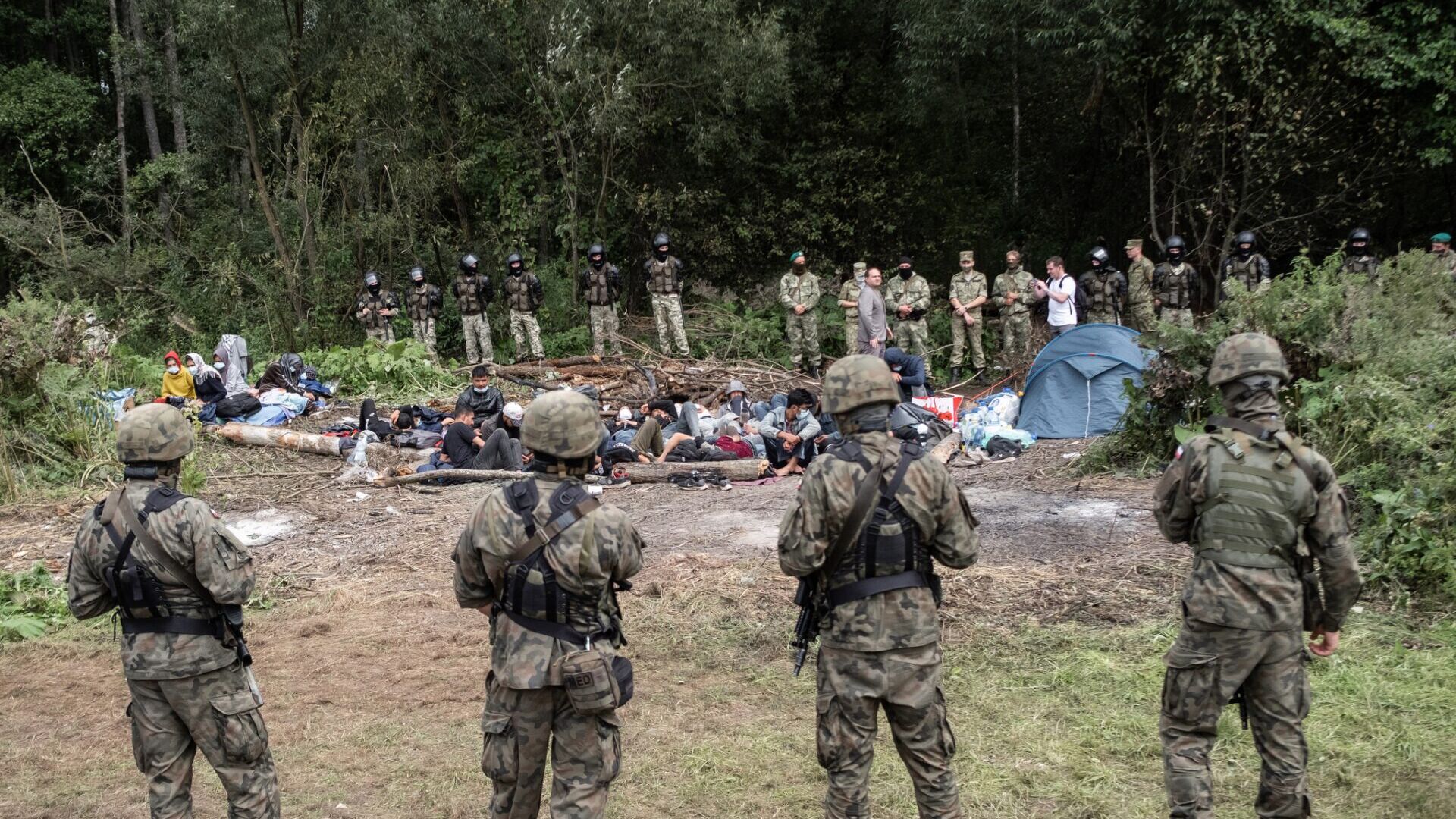 A group of migrants at the Belarus–Poland border in August 2021, close to the village of Usnarz Górny. Migrants are encircled by authorities from both sides, Polish authorities in front, Belarusian authorities at the treeline behind blocking them from advancing or retreating, caught in a state of enforced immobility. Photograph by Maciej Moskwa, 2021.
They ate grass, were beaten with batons and injured themselves on a border fence. In the winter of 2023, Khan and Abdullah, two Afghan men in their thirties, spent fifteen days trapped in the ‘death zone’, the deadly stretch of border land between Belarus and Poland. ‘I never thought this was possible in Europe.’
‘If the Polish police caught us, they beat us with batons.’
Khan** speaks calmly in Pashto*, occasionally staring into the distance in the flat in Antwerp. ‘They threw our food on the ground and broke the SIM trays in our phones, so we could no longer navigate.’
‘Because we had hardly any supplies, we ate grass,’ adds Abdullah**. Like his friend, he is wearing traditional Afghan clothes and sitting on a soft rug. Heavy traffic can be heard through the open window, and now and then a tram bell rings. ‘And we drank water from puddles and ditches.’
Missing in the border zone
In the autumn and winter of 2022–2023, Khan (33) and Abdullah (34) spend six months trying to reach the European Union via the Polish–Belarusian border, together with ten other Afghans. They spend fifteen days in the vast forest that lies between the two countries’ border fences.
In recent years, more than a hundred refugees have died in that area, according to a report by Border Forensics to which two Nijmegen researchers contributed. More than two hundred others have gone missing in the border region.
Under Afghanistan’s previous government, Khan and Abdullah served in the military. After the Taliban seized power in August 2021, they were imprisoned and severely mistreated. Once released, they decided to leave the country whatever the cost. ‘Our lives were at risk in Afghanistan,’ says Khan. ‘Many people who worked for the previous government have been murdered.’
According to a 2023 UN report, more than 200 former government officials and security personnel have been executed since the Taliban takeover in 2021. Between January and June 2024, 614 people, including 33 women, were detained without legal basis, according to a report by the Afghan human rights organisation Rawadari Foundation. Khan and Abdullah suspect the real numbers are much higher.
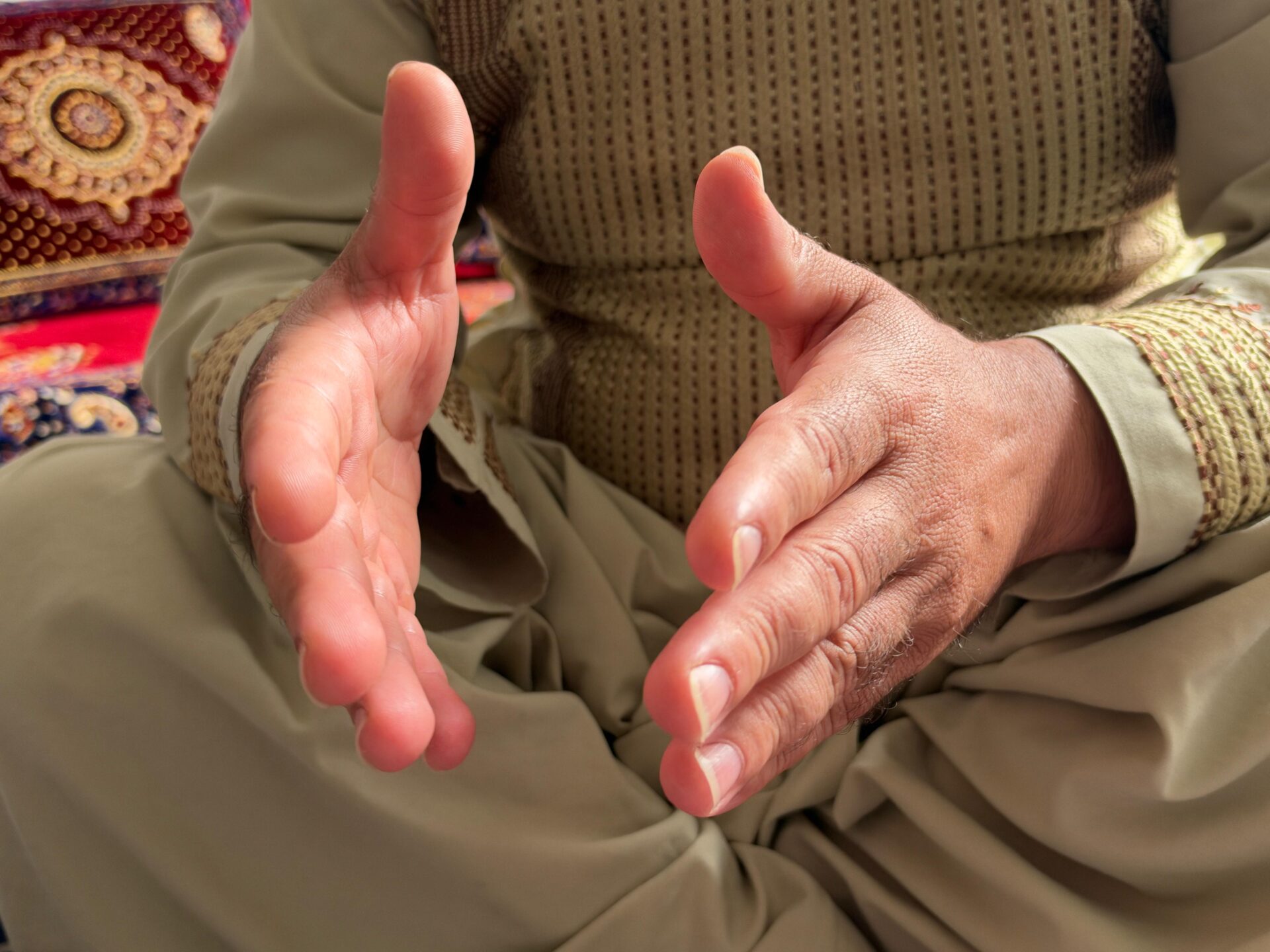
The two friends, who back up their story with photos and videos, initially want to travel to Europe via Turkey, but they are unable to obtain a visa. Together with ten other Afghans, they turn to smugglers, who promise to get them to Europe for 15,000 dollars per person, including food, accommodation and visas for Iran and Russia.
‘In the autumn of 2022 we boarded a plane in Iran to Russia. After fifteen days in Moscow, a smuggler drove us to just short of the Belarusian border.’
There, the Afghans are dropped off: they have to walk the last six hours on their own. Khan: ‘That was quite hard, because it was very cold, it had snowed and there were lots of puddles and streams. We had to drag our heavy backpacks through hilly forest. But it turned out to be nothing compared with what still lay ahead.’
According to the men, the twelve Afghans are then taken to Brest, a city near the Polish border on the Berlin–Moscow axis. ‘The smugglers had rented houses for us, which we weren’t allowed to leave. If we wanted food or cigarettes, we had to ask them.’
Pushbacks
From Brest, the smugglers drive the Afghans to a spot some thirty to forty kilometres from the Belarusian border fence – no one may come closer without a valid permit. The first part of their trek through the vast Białowieża Forest is led by a smuggler; the final stretch they must navigate themselves. Khan and Abdullah try to cross the border this way ten to twelve times.
Each attempt fails. ‘Sometimes we were intercepted in the forest by Belarusian border guards who sent us back,’ says Khan. ‘Sometimes we walked through the forest day and night, but the smuggler got lost and we had to walk back. Once we managed to cross the Belarusian fence, but then we were intercepted by the Polish border police, who sent us back to Belarus. We thought people in Europe would be very helpful and that they knew their own asylum and migration laws, but that turned out not to be the case.’
‘If they caught us, they immediately took our food and our phones’
Sending refugees back to Belarus, the so-called pushbacks by the Polish border police, is prohibited under European and international law. Anyone who reaches the European Union has the right to apply for asylum. At the time of Khan and Abdullah’s attempt, it was up to the European country concerned, in this case Poland, to assess on an individual basis whether asylum seekers would be in danger in their country of origin.
Both Belarusian and Polish officers use violence, says Khan. ‘They often used dogs. If they caught us, they immediately took our food and our phones. They threw our food on the ground. They also took us to a different place on the other side of the border, where we didn’t know the way. Without phones we had no contact with the smugglers; sometimes it took two or three days to reach the meeting point we’d agreed on.’
Ping-pong ball
But the hardest part of the journey is yet to come. At one point, the twelve Afghans spend fifteen days and nights in the death zone, the notorious strip of forest between the Polish and Belarusian border fences. If Polish border guards find them, they are sent back into the forest. At the Belarusian fence, they are sent the other way. The Afghans are bounced like a ping-pong ball between Polish pushbacks and Belarusian ‘pushforwards’ – in the middle of a harsh winter. ‘The smuggler had only given us food for one day: biscuits and muesli.’
Abdullah, too, calls this the hardest period of the journey. ‘There were thick piles of snow; we made fires to stay at least a little warm. And we were starving. Very occasionally a Polish border guard would pass a bit of food through the fence, but those were real exceptions.’
Khan shows some photos and videos from that time, in which he and Abdullah lie in a snowy forest in thick winter clothing and sleeping bags. In another video, in which both men can be seen, an Afghan man lies on the forest floor with a backpack as a neck rest. He laughs and says it isn’t so easy to get to Europe. Someone else tells the injured man not to make too much noise, or the police will come after them. ‘And then you’ll get kicked and beaten with sticks, just like Joorul and Ahmad.’
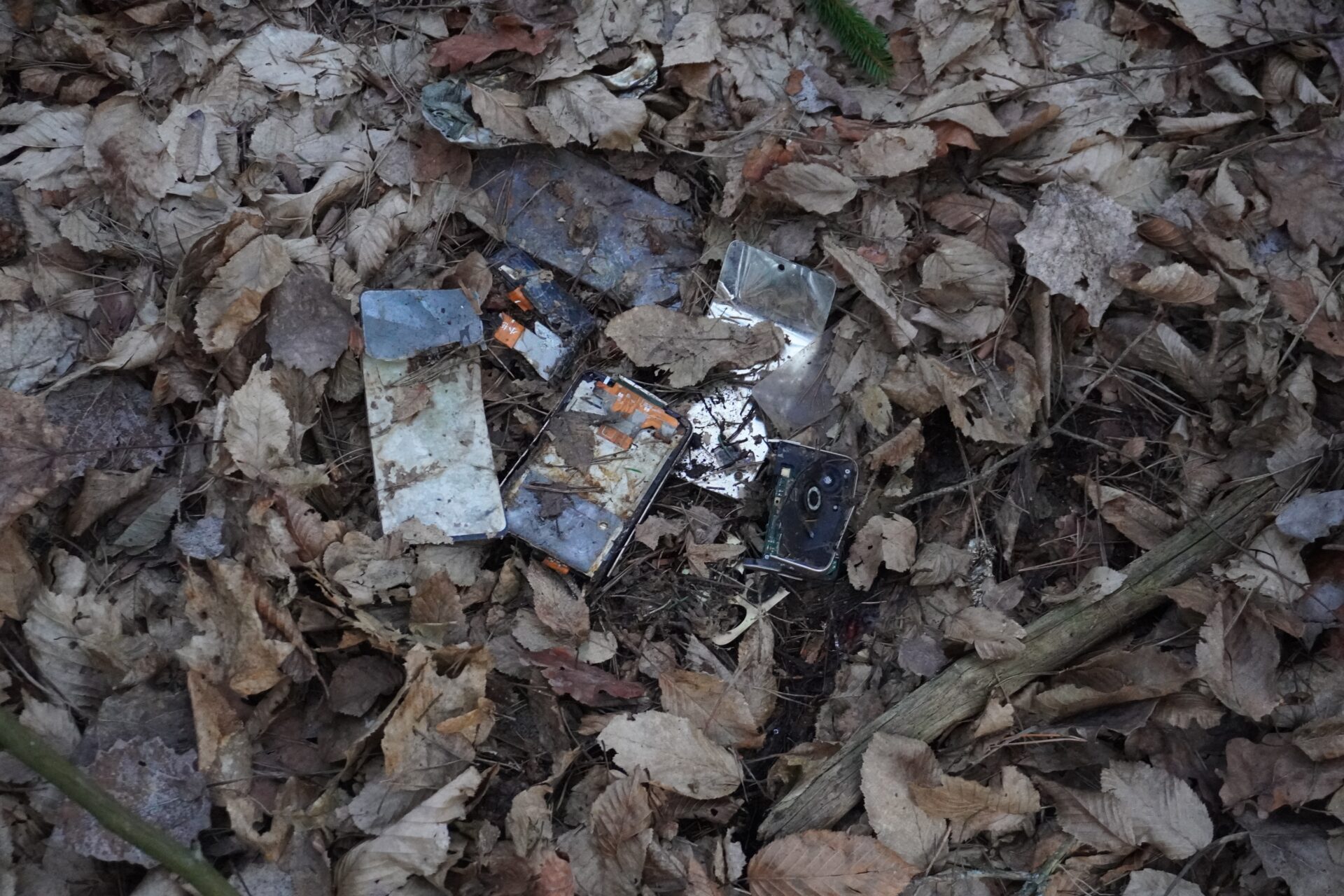
Time and again the Afghans try to reach Poland. Every attempt fails, and several times they are caught by the Polish police. Most of the examples of border-guard violence that Khan describes also appear in the Border Forensics report. ‘They used batons and they smashed our phones. They told us to walk back to Belarus. Refugees in our group with a broken foot and injured hands received no help. Each time we were taken to a different place along the border.’
‘Refugees with a broken foot and injured hands received no help’
The Belarusian border police didn’t follow the rules either, says Abdullah. ‘Once, when we were caught, they locked us in a small wooden hut completely surrounded by snow. It was minus 20 to minus 25 degrees Celsius in there, like a freezer. Only 24 hours later were we allowed out again.’
In the death zone, the Afghans are close to despair. ‘We had no wish left to keep living,’ says Khan. ‘But going back to Afghanistan wasn’t an option.’ On the fifteenth day, the badly weakened Afghans are finally able to return to Belarus and travel on to Minsk. ‘There we got care and medicine, and could regain our strength.’
Their next attempt to cross the border also fails: this time the refugees spend four days and nights in the border zone. ‘Again we were caught by the border police. Their faces were completely covered; we didn’t know who we were dealing with. These men used even more violence. Many refugees were injured or in shock and couldn’t move.’
Fingerprints
Together with the smuggler, Khan and Abdullah come up with a new plan to cross the border: in the death zone they build a ladder 5.5 metres high. At night they place it against the border wall and climb up. On the way down the Polish side, several refugees cut their hands open on the concertina wire, which, because of its blades, is even sharper than ordinary barbed wire.
But this time they manage to cross the wall without being caught. That night the Afghans walk forty kilometres through the forest until they find a place to sleep. Near a motorway they wait for the smuggler, hiding chest-deep in a small lake so as not to be seen. The driver takes them to the Polish–German border.
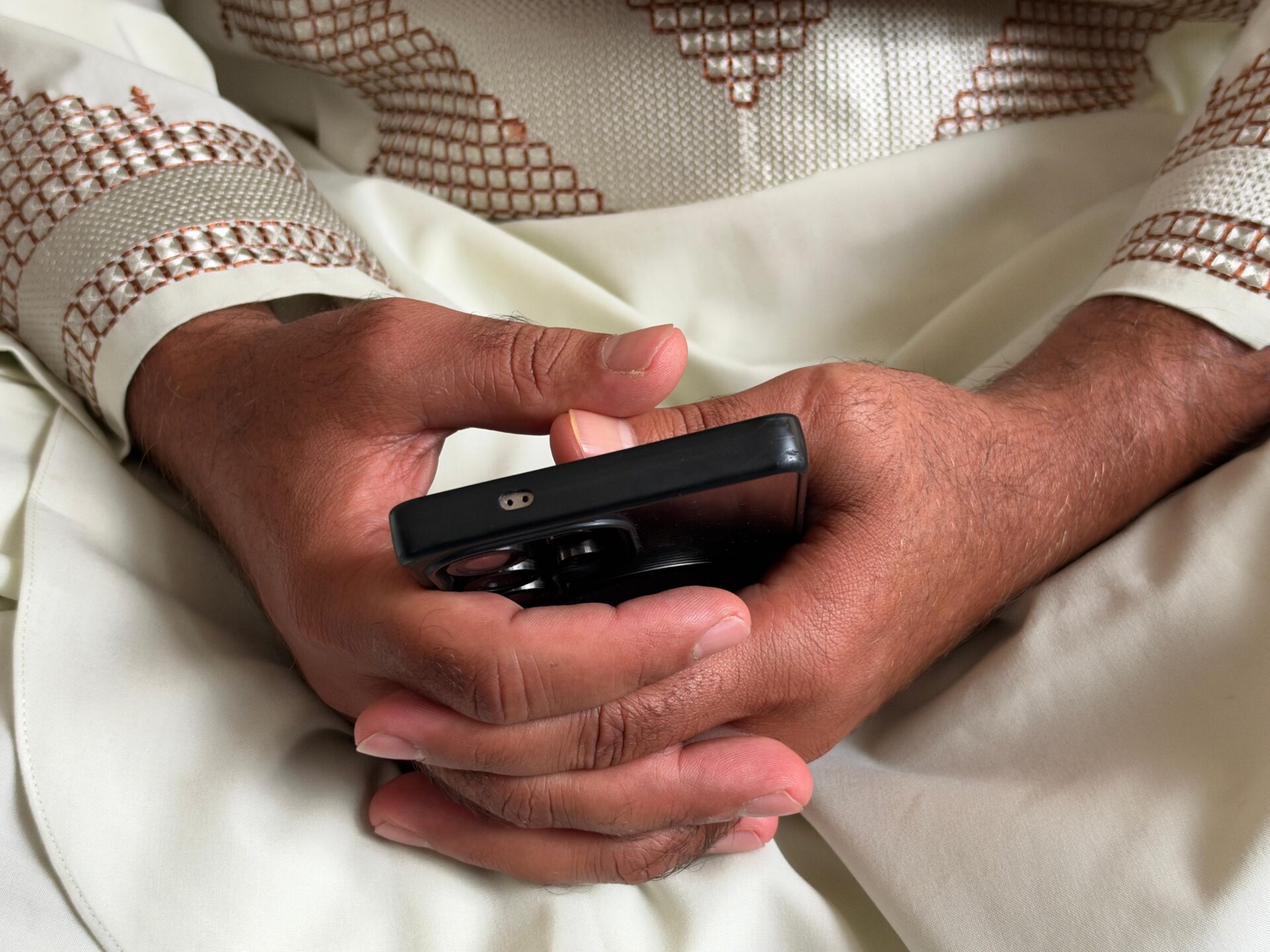
At a police check in Germany, the Afghans have their fingerprints taken. Under the European rules in force at the time, this means they have to go through the entire asylum procedure in Germany. But Khan and Abdullah decide to travel on to Belgium, where they have family. As a result, they will have to wait eighteen months before they can apply for asylum in Belgium. Until then, they are in the country illegally.
During a routine check in Belgium, Khan and Abdullah are arrested after all. They spend twenty days in prison and are then sent back to Germany. ‘Getting into Europe was physical torture, but this was a mentally very difficult time,’ says Khan. ‘All we wanted was to start working as soon as possible so we could support our families.’
A shop of his own
Both men are now doing well, they say, shortly before lamb, rice and bread are served. ‘Six months ago I got a residence permit,’ says Khan. ‘At last I could put the hard times behind me and look to the future. Now that I have a home, I can apply for my wife and children to join me. I hope they get a visa soon.’
Now and then Khan still looks at the photos and videos from three years ago. ‘I think: it’s unbelievable that we did this. And that people do such dangerous things to get to Europe.’
‘It’s unbelievable that people do such dangerous things to get to Europe’
Khan had heard from relatives and other refugees that people die or go missing trying to reach Europe by this route. ‘Some of our fellow travellers were in a very bad way at times during the journey. They suggested staying behind on their own, because they felt they were holding the rest of the group back.’
But the group had agreed beforehand to stay together for the whole journey. ‘In those cases we decided to rest for a while and give the remaining food to whoever couldn’t go on. Then we started walking slowly again and supported those who needed it. That’s why we all made it.’
Going back is not an option
Abdullah, who received his residence permit earlier, looks tired but content. After three years of waiting, on the very day of the interview he went to pick up his wife and three children at Zaventem airport. ‘I’m happy we can live here. I would have preferred to stay in Afghanistan, but unfortunately that isn’t possible. So we’re trying to make the best of our new life. Right now I’m taking Dutch lessons, and after that I’d like to open a shop of my own. I encourage my children to study hard here.’
The two Afghans welcome the attention the researchers’ report gives to the life-threatening situation on the Polish–Belarusian border. They hope it will resonate with policymakers, especially since refugees are still trying to cross. Abdullah: ‘From them I hear it has only become harder; border security has increased. Some have sold all the family jewellery to pay for the crossing. I hope these people aren’t forgotten, and that it becomes easier for them to travel to Europe in the future.’
*With thanks to Ghulamullah Habibi for interpreting.
**For safety reasons, the names Khan and Abdullah are pseudonyms. Their real names are known to the editors.